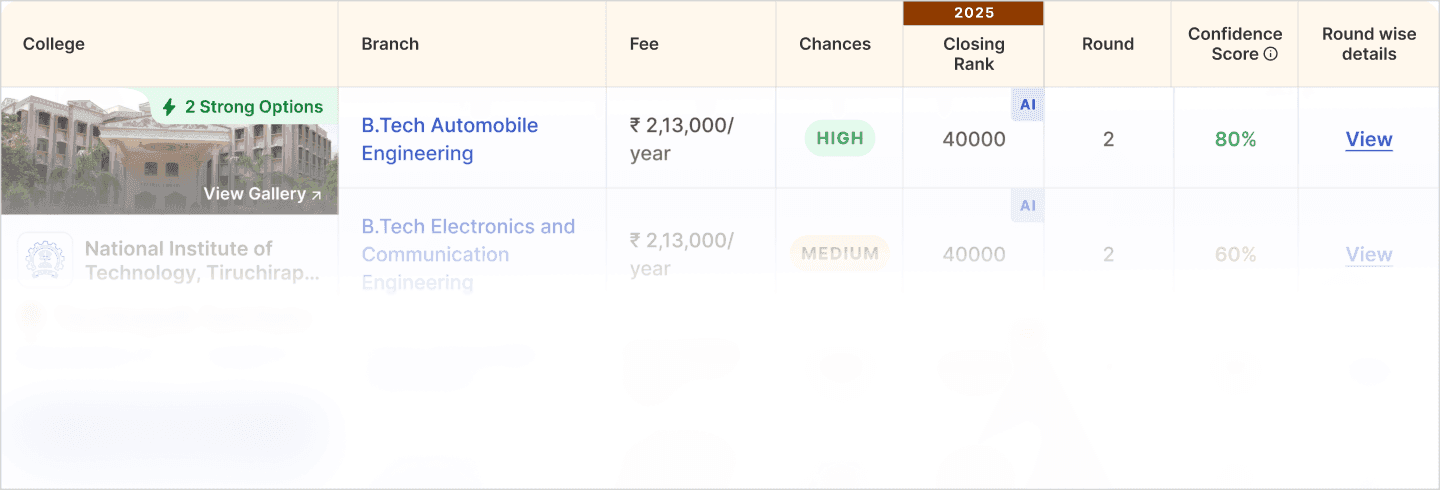
The Joint Entrance Examination (JEE) Main 2026 is India's premier engineering entrance exam, conducted by the National Testing Agency (NTA). It serves as the gateway to undergraduate engineering programs (B.E./B.Tech) at 31 NITs, 26 IIITs, and 38 GFTIs, and also acts as a qualifying exam for JEE Advanced. Our JEE Main 2026 College Predictor is an essential tool designed to help you navigate the complex admission landscape, providing personalized college and branch recommendations based on your expected performance. Make informed decisions for your future with findmycollege.com.


Trusted by 2.5L+ aspirants
Get Your Best-Fit Colleges
100% Secure
JEE main 2026 data
Instant Results

100% Secure
JEE main 2026 data
Instant Results

Predict your admission chances into top NITs, IIITs, and GFTIs.

Get personalized college and branch recommendations based on your JEE Main 2026 rank/score.

Explore category-wise (GEN, OBC-NCL, SC, ST, EWS, PwD) and home state/other state cutoffs.
Each predicted college shows your admission probability, the relevant closing rank for your category, and the branches likely to open up.
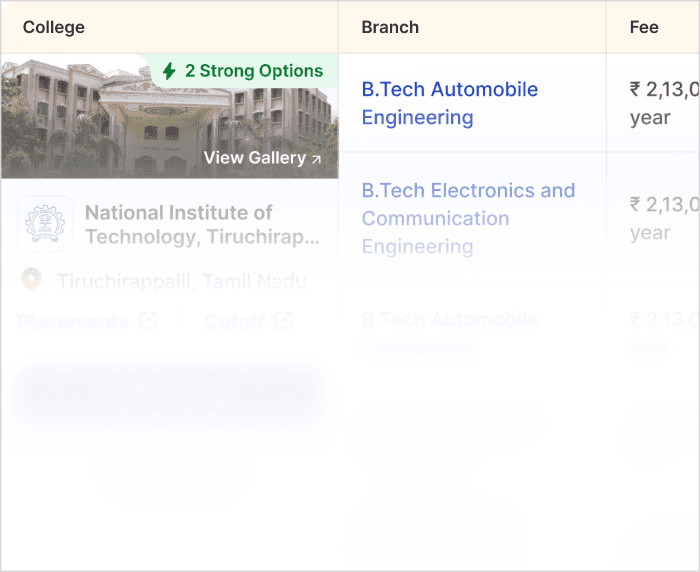
+ 18 more colleges in your list
Enter the details to get your
best-fit colleges
More JEE Main Rank-wise Cutoff Predictions
How the JEE main Predictor Works
Enter Your JEE Main 2026 Details
Input your expected JEE Main 2026 Rank or NTA Score, along with your category (General, OBC-NCL, SC, ST, EWS, PwD) and domicile state. These details are crucial for accurate prediction.
Get Personalized College & Branch Recommendations
Our advanced algorithm processes your data against historical JEE Main cutoffs and seat matrix data. You'll receive a list of potential NITs, IIITs, and GFTIs, along with specific engineering branches you might secure.
Explore Detailed Insights & Cutoffs
Dive deeper into each recommended college, view previous year's closing ranks for various branches, and understand your admission probability. This helps you strategize your JoSAA/CSAB counselling choices effectively.

Guidance from ex-IIT students & former JoSAA panel coordinators. Free 30-minute calls.
4.9/5 avg counsellor rating

Guidance from ex-IIT students & former JoSAA panel coordinators. Free 30-minute calls.
4.9/5 avg counsellor rating
How Does the JEE main Counselling Work?
01
JEE Main Result & Rank Declaration
02
JoSAA Registration & Choice Filling
03
Seat Allotment & Document Verification
04
CSAB Special Rounds (if applicable)
Key Factors Behind JEE main Seat Allocation

JEE Main Rank/NTA Score
Your All India Rank (AIR) in JEE Main 2026 is the primary determinant for seat allocation. NTA scores are normalized across multiple sessions to ensure fairness. Higher ranks generally lead to better college and branch options. Category ranks are also crucial for reserved category candidates.
Read More

Category & Quota
Reservation policies for OBC-NCL (27%), SC (15%), ST (7.5%), EWS (10%), and PwD (5%) play a significant role. Home State Quota (50% of seats in NITs/IIITs within the state) and Other State Quota (50%) are vital. Female Supernumerary Quota also impacts seat distribution. Candidates must provide valid category and domicile certificates during verification.
Read More

Choice Filling & Preference Order
The order in which you list your preferred colleges and branches during JoSAA/CSAB counselling is critical. An optimal choice filling strategy can maximize your chances of securing a desired seat. Researching previous year's cutoffs and your predicted rank helps in creating a realistic preference list. Avoid filling only a few choices; include a wide range of options.
Read More

Seat Matrix & Previous Year Cutoffs
The total number of seats available in each institute and branch (seat matrix) varies annually. Previous year's closing ranks serve as a strong indicator for predicting current year's cutoffs. Fluctuations in applicant numbers, exam difficulty, and candidate preferences can slightly alter cutoffs. Our predictor uses this historical data to provide the most accurate predictions.
Read More

JEE Main Rank/NTA Score
Your All India Rank (AIR) in JEE Main 2026 is the primary determinant for seat allocation. NTA scores are normalized across multiple sessions to ensure fairness. Higher ranks generally lead to better college and branch options. Category ranks are also crucial for reserved category candidates.
Read More

Category & Quota
Reservation policies for OBC-NCL (27%), SC (15%), ST (7.5%), EWS (10%), and PwD (5%) play a significant role. Home State Quota (50% of seats in NITs/IIITs within the state) and Other State Quota (50%) are vital. Female Supernumerary Quota also impacts seat distribution. Candidates must provide valid category and domicile certificates during verification.
Read More

Choice Filling & Preference Order
The order in which you list your preferred colleges and branches during JoSAA/CSAB counselling is critical. An optimal choice filling strategy can maximize your chances of securing a desired seat. Researching previous year's cutoffs and your predicted rank helps in creating a realistic preference list. Avoid filling only a few choices; include a wide range of options.
Read More

Seat Matrix & Previous Year Cutoffs
The total number of seats available in each institute and branch (seat matrix) varies annually. Previous year's closing ranks serve as a strong indicator for predicting current year's cutoffs. Fluctuations in applicant numbers, exam difficulty, and candidate preferences can slightly alter cutoffs. Our predictor uses this historical data to provide the most accurate predictions.
Read More
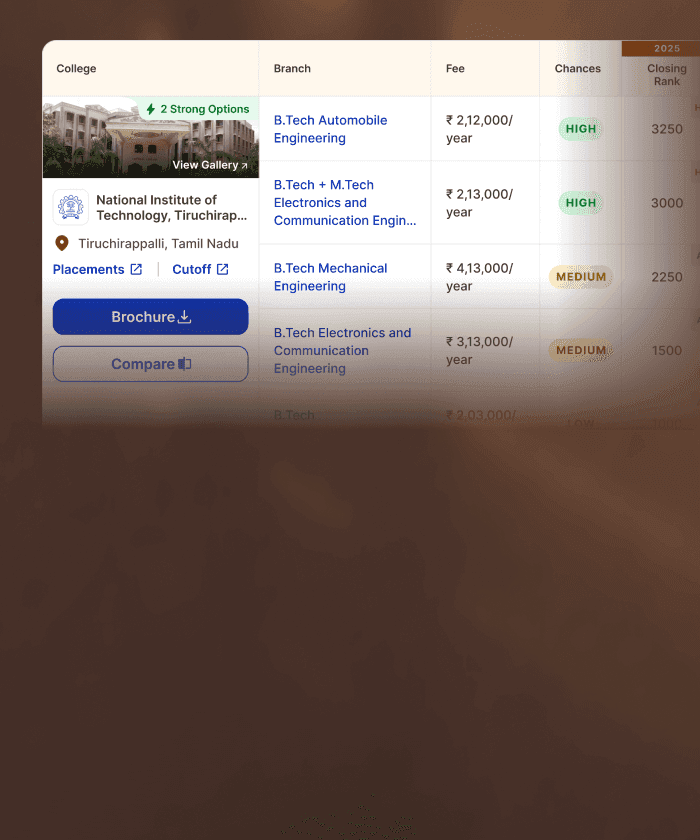

Predictions powered by real cutoff trends and expert insight.
Mistakes to Avoid During JEE main Counselling

WHY IT'S RISKY

WHAT TO DO
WHY IT'S RISKY
WHAT TO DO
WHY IT'S RISKY
WHAT TO DO
WHY IT'S RISKY
WHAT TO DO
JEE Main Accepting Colleges
College
Cutoff Round 1
Bachelor of Planning in Planning
Closing rank 2025 - 133
Bachelor of Architecture in Architecture
Closing rank 2025 - 151
Bachelor of Architecture
Closing rank 2025 - 164
Bachelor of Architecture in Architecture
Closing rank 2025 - 232
Bachelor of Planning in Planning
Closing rank 2025 - 342