Gujarat University Syllabus - Subject-Wise Topics & Full Curriculum


The Gujarat University Syllabus 2026 outlines the latest curriculum, course structure, and academic framework for undergraduate, postgraduate, diploma, and professional programmes offered by the university. Developed in line with the National Education Policy (NEP) 2020, the syllabus emphasises multidisciplinary learning, skill development, and outcome-based education through a Choice Based Credit System (CBCS). While the university introduced major curriculum reforms from the 2023–24 academic session, several programmes continue to follow the revised syllabus for the 2026 academic year unless updated further. Students can access programme-wise syllabi through the official Gujarat University website to review semester-wise subjects, credit distribution, examination schemes, and learning outcomes before the commencement of each academic session.
Table of Contents
Gujarat University Syllabus 2026: NEP 2020 Curriculum Structure
Gujarat University follows the National Education Policy (NEP) 2020 curriculum across its undergraduate, postgraduate, integrated, diploma, and professional programmes. Implemented from the 2023–24 academic session, the revised curriculum promotes multidisciplinary education, flexibility in subject selection, skill development, and experiential learning. The university has introduced a structured academic framework comprising Major and Minor disciplines, Skill Enhancement Courses (SEC), Value Added Courses (VAC), Multidisciplinary Courses (MDC), Ability Enhancement Courses (AEC), internships, and the Academic Bank of Credits (ABC).
The revised syllabus enables students to pursue interdisciplinary learning while fulfilling programme-specific credit requirements and preparing for higher education and industry-oriented careers.
| Particular | Details |
| Curriculum Framework | National Education Policy (NEP) 2020 |
| Implemented From | Academic Session 2023–24 |
| Applicable To | UG, PG, Integrated & Professional Programmes |
| Learning Model | Multidisciplinary & Outcome-Based Education |
| Course Components | Major, Minor, VAC, SEC, MDC, AEC |
| Internship | Mandatory for selected programmes |
| Credit System | Choice Based Credit System (CBCS) under NEP |
| Academic Bank of Credits (ABC) | Applicable |
| Multiple Exit Options | Available as per NEP Guidelines |
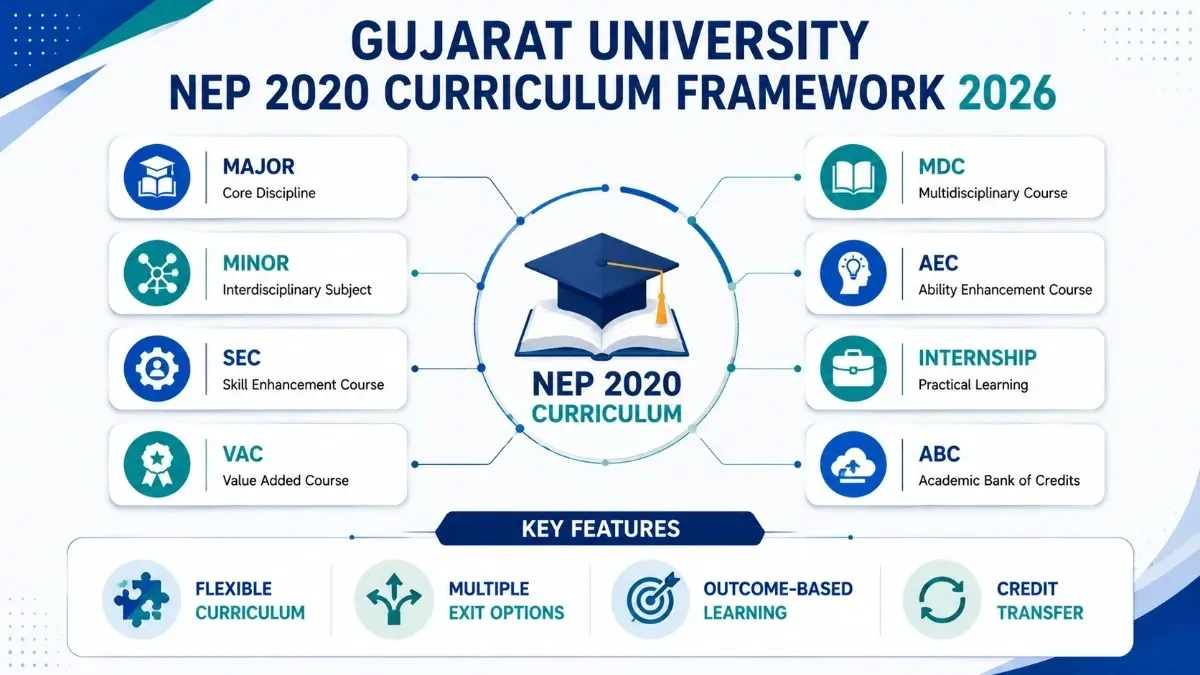
Students are advised to register for the Academic Bank of Credits (ABC) and follow the latest NEP guidelines issued by Gujarat University while selecting courses and completing programme requirements.
Direct link to download syllabus.
Gujarat University Syllabus 2026: Programme-wise Courses
Gujarat University publishes separate syllabus documents for undergraduate, postgraduate, integrated, law, commerce, management, science, education, and professional programmes. Every syllabus includes semester-wise papers, credit allocation, practical work, internal assessment, examination patterns, and learning outcomes prescribed by the respective Boards of Studies.
Popular Programmes Covered
| Programme Category | Courses |
| Undergraduate | BA, BCom, BSc, BBA, BCA, B.Ed |
| Postgraduate | MA, MCom, MSc, MBA, MCA, LLM |
| Integrated Programmes | BA LLB, BBA LLB, BCom LLB |
| Professional Courses | Law, Commerce, Education, Management |
| Research Programmes | MPhil (where applicable), PhD Coursework |
Recently Updated Programmes
| Programme | Latest Applicable Syllabus |
| MA English (CBCS) | Effective from 2025–26 |
| BCom Semester VI (NEP) | Latest NEP Curriculum |
| LLM (Business Law) | Revised from June 2026 |
| Three-Year LLB | Revised from June 2026 |
| BA LLB (Integrated) | Academic Session 2026–27 |
| BBA LLB (Integrated) | Academic Session 2026–27 |
| BCom LLB (Integrated) | Academic Session 2026–27 |
| BCom LLB (Hons.) | Academic Session 2026–27 |
The university regularly updates programme-specific syllabi whenever curriculum revisions are approved by the Academic Council or relevant Boards of Studies.
Gujarat University Syllabus 2026: Faculty-wise Syllabus
Gujarat University publishes separate syllabus documents for every faculty and academic department. Each syllabus contains semester-wise papers, credit allocation, practical components, examination schemes, learning outcomes, and recommended reading materials approved by the respective Boards of Studies. Students should always refer to the latest syllabus applicable to their department before the commencement of every semester.
| Faculty | Popular Courses |
| Arts | BA, MA, English, Gujarati, Hindi, Economics, Psychology, Sociology, History |
| Commerce | BCom, MCom, Accounting, Banking, Finance |
| Science | BSc, MSc, Physics, Chemistry, Mathematics, Biotechnology, Microbiology, Botany, Zoology |
| Computer Applications | BCA, MCA, Artificial Intelligence, Data Science |
| Law | LLB, BA LLB, BBA LLB, BCom LLB, LLM |
| Education | B.Ed., M.Ed. |
| Management | BBA, MBA |
| Professional & Integrated Programmes | Various integrated UG and PG courses |
The syllabus for every faculty is revised periodically based on recommendations of the respective Boards of Studies and approval from Gujarat University's Academic Council.
Gujarat University Syllabus 2026: NEP vs Previous CBCS Curriculum
The implementation of NEP 2020 marks one of the most significant curriculum reforms undertaken by Gujarat University. While the earlier syllabus followed the traditional Choice Based Credit System (CBCS), the new framework introduces multidisciplinary learning, flexible subject combinations, internships, and greater emphasis on skill development.
Major Changes Introduced Under NEP
| Previous CBCS Curriculum | NEP 2020 Curriculum |
| Fixed programme structure | Flexible multidisciplinary curriculum |
| Limited elective options | Major-Minor combinations |
| Traditional electives | VAC, SEC, MDC & AEC courses |
| Limited practical exposure | Internship & experiential learning |
| Conventional credit system | Academic Bank of Credits (ABC) |
| Programme-specific learning | Outcome-based education |
Important Curriculum Updates
| Update | Details |
| CBCS UG Framework | Effective from June 2015 |
| CBCS PG Framework | Effective from June 2010 |
| Major Curriculum Revision | Approximately 50 UG & PG subjects revised in 2018 |
| First-Year Syllabus Revision | Around 25–30% curriculum updated |
| UGC Alignment | Approximately 80% based on UGC Model Curriculum |
| NEP Implementation | Academic Session 2023–24 |
| Latest Law Curriculum Revision | June 2026 |
The revised curriculum aligns Gujarat University with the objectives of NEP 2020 by promoting interdisciplinary education, employability, research orientation, and academic flexibility.
Gujarat University Credit System & Course Components under NEP
Under the National Education Policy (NEP) 2020, Gujarat University follows a flexible credit-based curriculum that allows students to combine subjects across disciplines while developing academic, professional, and employability skills. Along with core courses, students must complete interdisciplinary, skill-based, and value-added components prescribed under the university's curriculum framework.
Major Course Components
| Component | Purpose |
| Major | Core discipline selected by the student |
| Minor | Additional subject from another discipline |
| VAC (Value Added Course) | Personality development, ethics, environmental awareness and life skills |
| SEC (Skill Enhancement Course) | Industry-oriented practical and employability skills |
| MDC (Multidisciplinary Course) | Interdisciplinary learning outside the major discipline |
| AEC (Ability Enhancement Course) | Communication skills, language proficiency and soft skills |
| Internship | Practical exposure and experiential learning for selected programmes |
| Academic Bank of Credits (ABC) | Digital storage and transfer of academic credits |
The revised curriculum encourages multidisciplinary education, flexibility in course selection, practical learning, and seamless credit transfer in accordance with NEP 2020 guidelines.
Gujarat University B.Ed Syllabus 2026: Course Structure
The Gujarat University Bachelor of Education (B.Ed.) programme follows a two-year curriculum consisting of theory courses, practical training, internships, school engagement activities, and teaching practice. The programme is designed to develop professional teaching competencies through a balanced combination of classroom instruction and field experience.
B.Ed Programme Details
| Particular | Details |
| Programme | Bachelor of Education (B.Ed.) |
| Duration | 2 Years |
| Programme Level | Undergraduate |
| Curriculum Framework | CBCS / NEP-based Curriculum |
| Department | A.G. Teachers College |
| Original Framework Effective From | June 2015 |
Semester-wise Credit Distribution
| Semester | Theory Credits | Practical Credits | Total Credits |
| Semester I | 16 | 10 | 26 |
| Semester II | 16 | 10 | 26 |
| Semester III | 8 | 14 | 22 |
| Semester IV | 12 | 12 | 24 |
| Total | 52 | 46 | 98 |
The B.Ed syllabus also includes teaching practice, lesson planning, school internships, internal assessment, practical examinations, and professional skill development activities to prepare future educators for classroom teaching.
How to Download Gujarat University Syllabus 2026
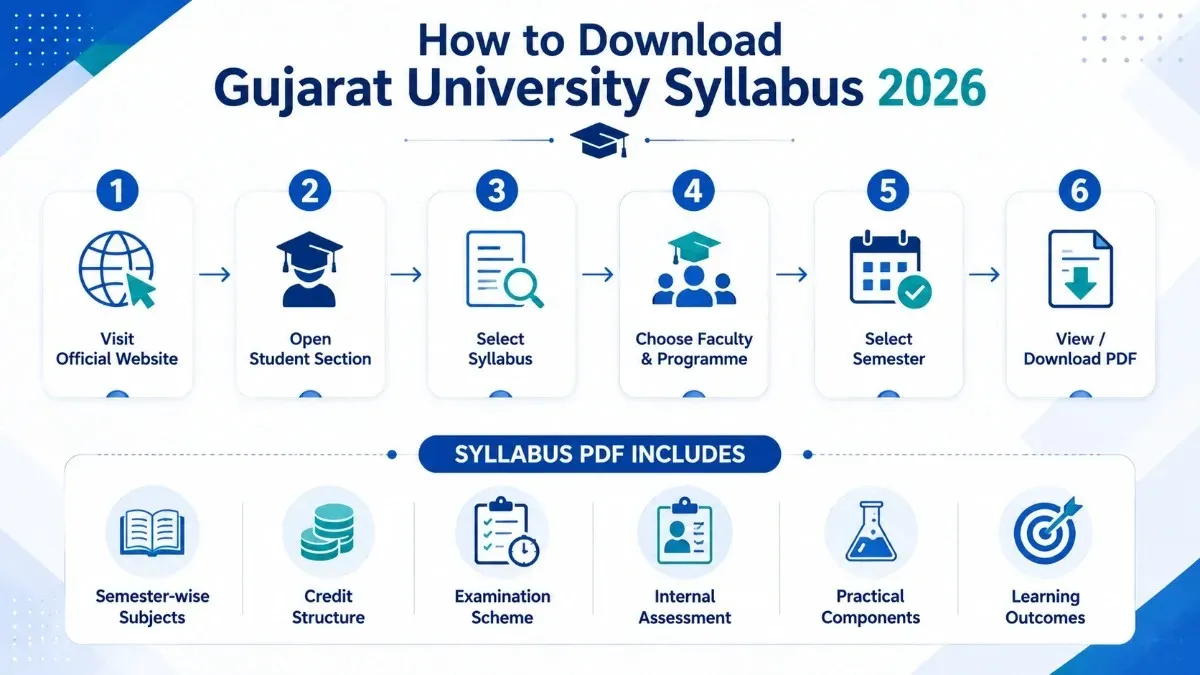
Students can download the latest syllabus for their respective programmes through the official Gujarat University website. Separate syllabus documents are available for undergraduate, postgraduate, integrated, law, commerce, science, management, education, and professional programmes.
Steps to Download the Syllabus
- Visit the official Gujarat University website.
- Navigate to the Student section.
- Click on Syllabus.
- Select your faculty or programme.
- Choose the appropriate course and semester.
- Open the syllabus document.
- View or download the syllabus for future reference.
Information Available in the Syllabus
| Includes |
| Programme Structure |
| Semester-wise Subjects |
| Credit Distribution |
| Major & Minor Papers |
| Practical Components |
| Internal Assessment |
| Examination Scheme |
| Learning Outcomes |
| Reference Books |
| Course Objectives |
The official syllabus serves as the primary academic reference for students and should be consulted before the commencement of each semester to stay informed about any curriculum revisions or programme updates.
What Does the Gujarat University Syllabus Include?
Each syllabus published by Gujarat University serves as the official academic guide for students enrolled in undergraduate, postgraduate, professional, and integrated programmes. Besides listing semester-wise subjects, the syllabus explains the academic structure, assessment methods, practical requirements, and expected learning outcomes for every course.
| Information Available | Details |
| Programme Structure | Semester-wise curriculum |
| Subject List | Core, Elective, Major and Minor papers |
| Credit Distribution | Credits assigned to each paper |
| Practical Components | Laboratory work, internships, projects and fieldwork |
| Internal Assessment | Continuous assessment and sessional evaluation |
| End Semester Examination | Theory and practical examination pattern |
| Learning Outcomes | Programme and course outcomes |
| Reference Books | Recommended textbooks and study resources |
| Examination Scheme | Marks distribution and evaluation process |
Students should refer to the latest syllabus issued by the university before the start of each semester, as curriculum revisions may be introduced periodically.
Frequently Asked Questions
What is the Gujarat University Syllabus 2026?

fits you best?
Get personalized guidance from our admission counselors