

BITSAT Syllabus 2026: Subject-wise Topics, Exam Pattern & PDF


The BITSAT-2026 syllabus covers the subjects and topics tested in the entrance examination for admission to BITS Pilani’s Integrated First Degree programmes for the 2026–27 academic year. The test includes Physics, Chemistry, English Proficiency, Logical Reasoning and Mathematics or Biology, depending on the programme and the candidate’s Class 12 subject combination. BITS Pilani recommends NCERT textbooks as a reference for the prescribed syllabus content. Candidates should prepare across the complete Class 11 and Class 12 syllabus rather than rely on unofficial chapter-wise or class-wise weightage estimates. BITS Pilani has not published a fixed percentage split between Class 11 and Class 12 questions for BITSAT-2026. The syllabus, therefore, should be approached comprehensively, with equal attention to concepts, application and speed.
Table of Contents
BITSAT 2026 Exam Pattern
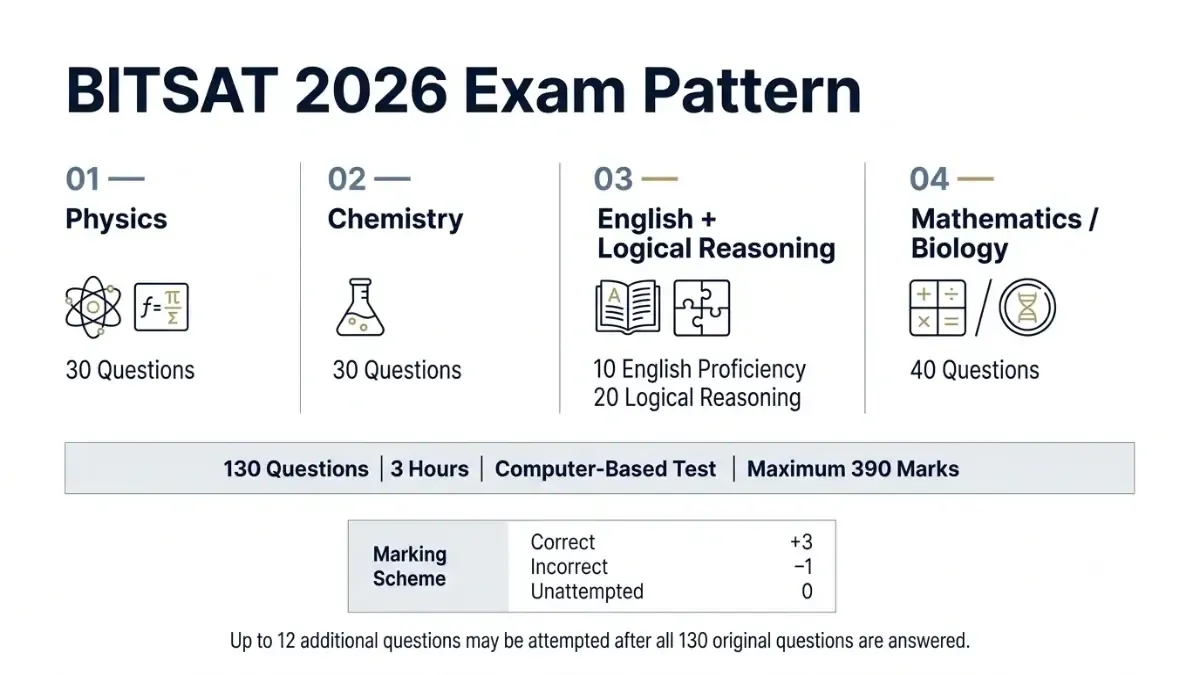
BITSAT-2026 is a computer-based test conducted for three hours without a break.
The paper contains 130 questions across Physics, Chemistry, English Proficiency, Logical Reasoning and Mathematics or Biology.
| Part | Subject | Questions |
| I | Physics | 30 |
| II | Chemistry | 30 |
| III(a) | English Proficiency | 10 |
| III(b) | Logical Reasoning | 20 |
| IV | Mathematics or Biology | 40 |
| Total | 130 |
Mathematics is used for B.E. and applicable M.Sc. programmes. Biology is available for B.Pharm. and B.E. Environmental and Sustainability Engineering candidates who use the PCB route.
BITSAT 2026 Marking Scheme
- Correct answer: +3 marks.
- Incorrect answer: −1 mark.
- Unattempted answer: 0 marks.
- Maximum marks for the 130-question paper: 390.
- Questions are objective-type with four answer choices.
- Only one option is correct.
- Candidates can move between questions and change answers during the main test.
- There is no separate time limit for individual parts.
After answering all 130 questions, candidates may receive up to 12 extra questions if time remains. These extra questions are from Physics, Chemistry, Mathematics/Biology and Logical Reasoning. Once a candidate begins the extra-question section, they cannot return to the earlier 130 questions.
Click here to download the BITSAT Syllabus.
BITSAT 2026 Subjects
BITSAT-2026 includes five subject areas in the examination.
The final subject combination depends on the programme and the candidate’s Class 12 subject combination.
The examination includes:
- Physics.
- Chemistry.
- English Proficiency.
- Logical Reasoning.
- Mathematics or Biology.
Candidates should prepare according to the subject combination required for the programme to which they are applying. BITSAT-2026 is not simply a Mathematics-only examination for every First Degree programme.
BITSAT Physics Syllabus
The Physics syllabus covers mechanics, thermal physics, electricity, magnetism, optics, modern physics and electronic devices.
Candidates should cover the complete senior-secondary Physics content rather than rely on unofficial chapter-wise weightage.
| Unit | Major topics |
| Units and measurements | SI units, dimensions, significant figures, measurement instruments and errors |
| Kinematics | Vectors, motion in one and two dimensions, projectile motion, circular motion and relative motion |
| Newton’s laws | Laws of motion, friction, free-body diagrams, inclined planes, pulleys and circular motion |
| Impulse and momentum | Conservation of momentum, collisions, centre of mass and impulse |
| Work, energy and power | Work-energy theorem, kinetic and potential energy, conservative forces and power |
| Rotational motion | Torque, angular momentum, moment of inertia, rolling and rotational kinematics |
| Gravitation | Gravitational field and potential, satellites, escape velocity and Kepler’s laws |
| Properties of matter | Elasticity, pressure, viscosity, surface tension, buoyancy and Bernoulli’s principle |
| Oscillations | Simple harmonic motion, spring-mass systems, pendulums, damping, forced oscillations and resonance |
| Waves | Progressive and standing waves, strings, pipes, beats, superposition and Doppler effect |
| Heat and thermodynamics | Thermal expansion, calorimetry, kinetic theory, laws of thermodynamics, heat engines and refrigeration |
| Electrostatics | Coulomb’s law, electric field, potential, Gauss’s law, dipoles, capacitance and dielectrics |
| Current electricity | Ohm’s law, resistivity, circuits, Kirchhoff’s laws, cells, potentiometer and Wheatstone bridge |
| Magnetic effects of current | Biot–Savart law, Ampere’s law, Lorentz force, current-carrying conductors and magnetic dipoles |
| Electromagnetic induction and alternating current | Faraday’s law, Lenz’s law, inductance, transformers, generators, AC and LCR circuits |
| Optics | Reflection, refraction, mirrors, lenses, optical instruments, interference, diffraction and polarisation |
| Modern physics | Photoelectric effect, de Broglie wavelength, atomic models, radioactivity, nuclear physics and binding energy |
| Electronic devices | Semiconductors, diodes, rectifiers, LEDs, photodiodes, solar cells, transistors and logic gates |
Physics Preparation Note
The official brochure recommends NCERT textbooks for the syllabus content.
Candidates should not rely on unofficial topic-wise percentages because BITS Pilani does not publish a guaranteed chapter-wise question distribution.
BITSAT Chemistry Syllabus
The Chemistry syllabus covers Physical, Inorganic and Organic Chemistry.
Preparation should include concepts, reactions, numerical applications and practical chemistry.
| Area | Major topics |
| Some basic concepts | Mole concept, stoichiometry, atomic and molecular masses, concentration terms and chemical calculations |
| Atomic structure | Atomic models, quantum numbers, electronic configuration, orbitals and spectra |
| Periodicity | Periodic table, periodic properties and trends |
| Chemical bonding | Ionic and covalent bonding, Lewis structures, VSEPR, hybridisation, molecular orbitals and hydrogen bonding |
| States of matter | Gas laws, kinetic theory, liquids, solids and intermolecular forces |
| Thermodynamics | Enthalpy, entropy, Gibbs energy, Hess’s law and spontaneity |
| Equilibrium | Chemical equilibrium, Le Chatelier’s principle, ionic equilibrium, acids, bases, pH and solubility |
| Redox chemistry | Oxidation numbers, balancing redox reactions and electrochemical principles |
| Electrochemistry | Galvanic cells, electrode potential, Nernst equation, conductance and electrolysis |
| Chemical kinetics | Rate laws, order, molecularity, activation energy and Arrhenius equation |
| Solutions | Concentration, colligative properties and related calculations |
| Hydrogen and s-block elements | Properties, compounds and important reactions |
| p-block elements | Trends, compounds and reactions of selected p-block groups |
| d- and f-block elements | Transition elements, coordination chemistry and lanthanides/actinides |
| Organic fundamentals | Nomenclature, isomerism, reaction mechanisms and electronic effects |
| Hydrocarbons | Alkanes, alkenes, alkynes, aromatic compounds and their reactions |
| Oxygen-containing compounds | Alcohols, phenols, ethers, aldehydes, ketones, carboxylic acids and derivatives |
| Nitrogen-containing compounds | Amines, diazonium compounds and related reactions |
| Biomolecules and polymers | Carbohydrates, proteins, nucleic acids, polymers and chemistry in everyday life |
| Environmental and industrial chemistry | Pollution, green chemistry and selected industrial processes |
| Experimental chemistry | Basic laboratory principles, qualitative analysis and practical chemistry |
The Chemistry topics should be treated as a syllabus guide rather than a guaranteed question-weightage distribution.
BITSAT Mathematics Syllabus
The Mathematics paper applies to B.E. and applicable M.Sc. programmes.
The syllabus covers algebra, calculus, coordinate geometry, vectors, probability, statistics and other senior-secondary mathematical topics.
| Unit | Major topics |
| Sets, relations and functions | Sets, relations, functions, composition, inverse functions and graphs |
| Algebra | Complex numbers, quadratic equations, sequences and series, logarithms, binomial theorem and mathematical induction |
| Permutations and combinations | Fundamental counting principle, arrangements, selections and related applications |
| Matrices and determinants | Types of matrices, determinants, inverse matrices and systems of linear equations |
| Trigonometry | Identities, equations, inverse functions, graphs and properties of triangles |
| Coordinate geometry | Straight lines, pairs of lines, circles, parabola, ellipse and hyperbola |
| Three-dimensional geometry | Direction ratios, direction cosines, lines, planes, angles and distances |
| Differential calculus | Limits, continuity, differentiation and applications of derivatives |
| Integral calculus | Indefinite and definite integrals, area and applications |
| Differential equations | Formation and solution of basic first-order differential equations |
| Vectors | Vector algebra, scalar and vector products and geometric applications |
| Probability | Conditional probability, Bayes’ theorem, random variables and distributions |
| Statistics | Measures of central tendency, dispersion and data interpretation |
| Linear programming | Constraints, feasible regions and optimisation |
| Mathematical modelling | Formulation and application of mathematical models |
The Mathematics syllabus should be prepared from the prescribed BITSAT content and not treated as a simple reproduction of every NCERT exercise.
BITSAT Biology Syllabus
Biology is available for candidates applying through the PCB route for B.Pharm. and B.E. Environmental and Sustainability Engineering.
The syllabus covers cell biology, physiology, genetics, ecology, biotechnology and other core Biology areas.
| Area | Major topics |
| Diversity of living organisms | Classification, taxonomy, plant groups and animal groups |
| Cell biology | Cell structure, biomolecules, cell cycle, mitosis and meiosis |
| Plant anatomy and physiology | Tissues, transport, mineral nutrition, photosynthesis, respiration and plant growth |
| Human physiology | Digestion, breathing, circulation, excretion, nervous system, endocrine system and reproduction |
| Reproduction | Sexual reproduction in plants, human reproduction and reproductive health |
| Genetics | Mendelian inheritance, molecular basis of inheritance, DNA, RNA and genetic expression |
| Evolution | Origin of life, evidence for evolution and evolutionary principles |
| Ecology | Organisms and populations, ecosystems, biodiversity, conservation and environmental issues |
| Biology and human welfare | Human health, disease, immunity, microbes and their uses |
| Biotechnology | Principles, processes and applications of biotechnology |
PCB Applicants
Candidates applying through the PCB route should note:
- Biology replaces Mathematics in the BITSAT paper.
- PCB-based admission is relevant to B.Pharm. and B.E. Environmental and Sustainability Engineering.
- PCB candidates must satisfy the programme-specific Class 12 subject and marks requirements.
- PCB candidates entering B.E. Environmental and Sustainability Engineering must also have Mathematics proficiency at the Class 10 level, according to the 2026 brochure.
English Proficiency Syllabus
The English Proficiency section contains 10 questions and tests practical command of English.
Preparation should focus on grammar, vocabulary, reading comprehension and sentence-level usage.
| Area | Topics |
| Grammar | Sentence structure, parts of speech, tenses, articles, prepositions, conjunctions and agreement |
| Vocabulary | Synonyms, antonyms, word meanings, usage and contextual vocabulary |
| Reading comprehension | Short passages, inference, main idea and supporting details |
| Sentence completion | Appropriate words, phrases and grammatical forms |
| Error identification | Incorrect grammar, usage or sentence construction |
| Rearrangement | Ordering words, phrases or sentences logically |
Candidates should prepare through reading comprehension, grammar revision and timed vocabulary practice.
Logical Reasoning Syllabus
The Logical Reasoning section contains 20 questions.
It covers verbal, analytical, numerical, spatial and visual reasoning.
| Area | Topics |
| Verbal reasoning | Analogies, classification, series, coding-decoding and logical statements |
| Non-verbal reasoning | Patterns, figures, mirror images and visual relationships |
| Analytical reasoning | Arrangements, sequencing, conditions and deductions |
| Numerical reasoning | Number series, simple quantitative relationships and data-based logic |
| Spatial reasoning | Direction sense, paper folding, embedded figures and visualisation |
| Data interpretation | Tables, charts and basic logical analysis |
BITS Pilani does not publish an official chapter-wise weightage table for Logical Reasoning. Preparation websites may give expected distributions, but those are not guaranteed for the examination.
Class 11 and Class 12 Coverage
BITSAT draws substantially on senior-secondary Physics, Chemistry, Mathematics and Biology content.
Candidates should cover both Class 11 and Class 12 topics thoroughly because the official brochure does not provide a fixed Class 11/Class 12 question-weightage split.
The frequently quoted 40–45% and 55–60% figures should therefore be treated only as unofficial estimates and not as official BITS Pilani data.
BITSAT Syllabus Versus JEE Main Syllabus
BITSAT and JEE Main overlap substantially in senior-secondary science content.
However, their subject combinations, examination patterns, marking schemes and admission processes are different.
| Feature | BITSAT | JEE Main |
| Main subjects | Physics, Chemistry, Mathematics/Biology, English and Logical Reasoning | Physics, Chemistry and Mathematics for Paper 1 |
| Exam mode | Computer-based | Computer-based |
| Negative marking | −1 for an incorrect answer | Subject- and paper-specific rules |
| Extra questions | Up to 12 after all 130 questions are answered | No equivalent BITSAT extra-question option |
| Main skill emphasis | Speed, accuracy, conceptual application and reasoning | Conceptual understanding, numerical application and examination strategy |
| Admission use | BITS Pilani First Degree programmes | NITs, IIITs, GFTIs and qualification for JEE Advanced |
Candidates should not prepare from the JEE Main syllabus alone because BITSAT also tests English Proficiency and Logical Reasoning.
How to Download the BITSAT Syllabus PDF
Candidates can download the official BITSAT-2026 brochure and syllabus from the BITS Pilani admissions website.
The brochure contains the examination pattern, eligibility information, programme details and syllabus annexure.
Steps to Download
- Visit the BITS Pilani Admissions website.
- Open the First Degree or BITSAT-2026 section.
- Download the BITSAT-2026 brochure.
- Go to the syllabus annexure in the brochure.
- Check the programme-specific eligibility and subject requirements.
- Recheck the official website for corrections or revised notices.
The official BITSAT-2026 brochure includes the exam pattern, eligibility, important dates, fee information, programme list and syllabus annexure.
BITSAT 2026 Exam Dates
The 2026 examination schedule covers application, both test sessions and the subsequent admission-preference process.
As the 2026 examination cycle has passed, these dates should be treated as the BITSAT 2026 schedule, rather than upcoming dates.
| Event | Date |
| Application begins | 15 December 2025 |
| Session 1 application deadline | 16 March 2026 |
| Session 1 test | 15–17 April 2026 |
| Session 2-only application window | 20 April–2 May 2026 |
| Session 2 test | 24–26 May 2026 |
| Admission application with Class 12 marks and preferences | 21 April–1 June 2026 |
| Iteration I admit and waitlist announcement | 15 June 2026 |
| Offer acceptance deadline | 22 June 2026 |
The brochure marked the schedule as tentative, while BITS Pilani subsequently published the detailed 2026 admission schedule on its admissions website.
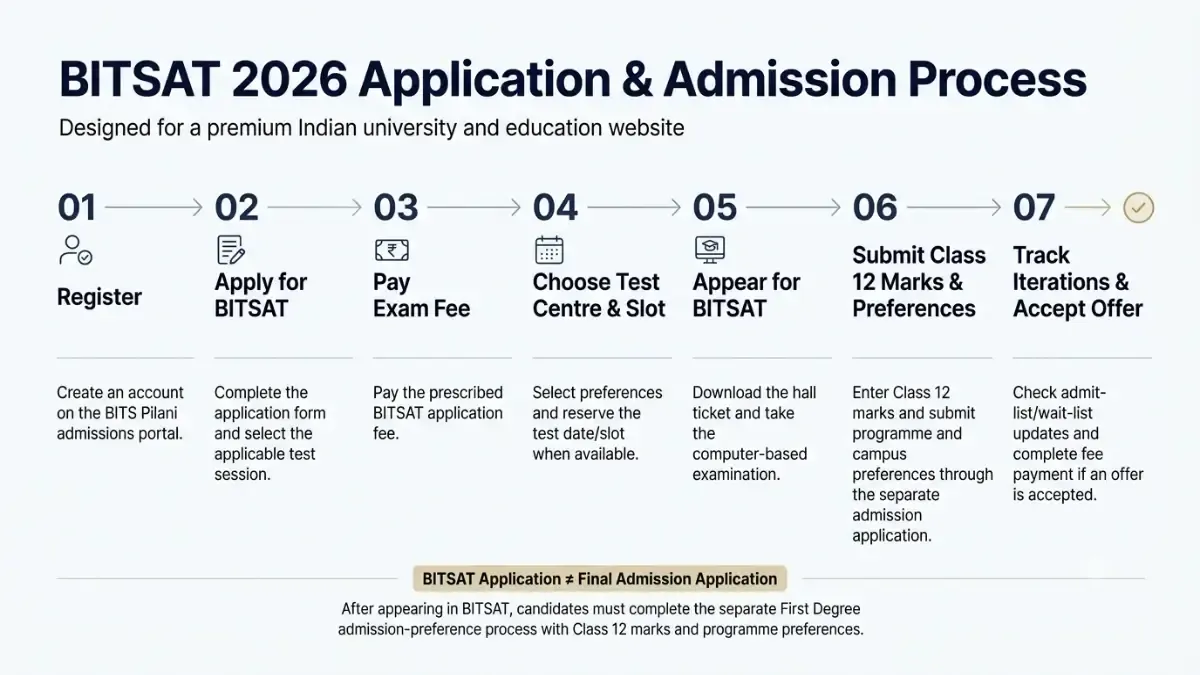
BITSAT 2026 Application and Admission Process
Appearing for BITSAT is not the complete admission process.
Candidates must also complete the separate First Degree admission-preference process after submitting their Class 12 marks.
BITSAT Application
- Register on the official BITS admissions portal.
- Complete the online application.
- Select Session 1, both sessions or the applicable Session 2 option.
- Pay the prescribed examination fee.
- Choose test-centre preferences.
- Reserve a test date and slot when the window opens.
- Download the hall ticket.
- Appear for the computer-based test.
Admission Application After BITSAT
Candidates seeking admission must also:
- Submit Class 12 marks.
- Upload the marksheet or certificate when available.
- Enter programme and campus preferences.
- Pay the prescribed admission-application fee.
- Submit the preference form by the deadline.
- Track iteration, admit-list and wait-list results.
- Accept the offer and pay the required fee by the deadline.
The official brochure states that candidates must apply for admission separately by submitting their Class 12 marks and programme preferences after appearing in BITSAT.
BITSAT Eligibility 2026
BITSAT eligibility varies according to the programme and subject combination.
Candidates should check the official 2026 eligibility requirements before applying.
B.E. and Most M.Sc. Programmes
Candidates generally need:
- Class 12 or an equivalent qualification from a recognised board.
- At least five subjects, including Physics, Chemistry, Mathematics, one language and one additional subject.
- At least 75% aggregate marks in Physics, Chemistry and Mathematics.
- At least 60% marks individually in Physics, Chemistry and Mathematics.
- First appearance in Class 12 in 2025 or 2026, subject to the brochure’s conditions.
B.Pharm. and PCB Route
Candidates generally need:
- Class 12 or equivalent.
- Physics, Chemistry, Biology or Mathematics, one language and an additional subject.
- At least 75% aggregate marks in Physics, Chemistry and Biology/Mathematics.
- At least 60% individually in Physics, Chemistry and Biology/Mathematics.
- Mathematics proficiency at Class 10 level for PCB candidates applying to B.E. Environmental and Sustainability Engineering.
The official BITSAT brochure should be used for exact improvement-exam, board, result-submission and subject rules.
BITSAT 2026 Preparation Strategy
Preparation should cover all sections included in the candidate’s BITSAT paper.
Because the examination has 130 questions to be attempted within three hours, candidates should combine syllabus coverage with timed practice.
Physics
- Complete mechanics, thermal physics, electricity, magnetism, optics and modern physics.
- Practise short numerical problems.
- Revise formulas and units regularly.
- Include semiconductor and electronic-device topics.
Chemistry
- Use NCERT for inorganic chemistry and important reactions.
- Practise numerical problems in physical chemistry.
- Build a reaction and mechanism revision sheet for organic chemistry.
- Revise periodic trends, coordination chemistry and named reactions.
Mathematics
- Prioritise algebra, calculus, coordinate geometry, vectors and probability.
- Practise timed mixed-topic sets.
- Improve calculation speed.
- Review mistakes rather than only attempting new questions.
Biology
- Use NCERT diagrams, definitions and processes.
- Revise genetics, human physiology, ecology, cell biology and biotechnology.
- Practise objective questions under time limits.
English and Logical Reasoning
- Read short passages daily.
- Revise grammar and vocabulary.
- Practise series, coding, arrangements, analogy and visual-reasoning questions.
- Do not ignore these 30 questions; they form a meaningful part of the paper.
Time Management
BITSAT has 130 questions in 180 minutes, which gives an average of approximately 83 seconds per question before considering review time. Candidates should avoid spending too long on one question and should use the extra-question option only after answering the original 130 questions confidently.
- 30 Physics.
- 30 Chemistry.
- 10 English Proficiency.
- 20 Logical Reasoning.
- 40 Mathematics or Biology.
A candidate may attempt up to 12 additional questions after answering all 130 original questions.
Frequently Asked Questions
Where can I download the BITSAT syllabus?
The official syllabus is available in the BITSAT-2026 brochure on the BITS Pilani Admissions website.
Which subjects are included in BITSAT?
BITSAT includes Physics, Chemistry, English Proficiency, Logical Reasoning and Mathematics or Biology.
Is BITSAT based on NCERT?
The official brochure recommends NCERT textbooks for the syllabus content. Candidates should also consult the official BITSAT syllabus annexure.
Is there an official Class 11/Class 12 weightage?
No fixed Class 11/Class 12 percentage split is published in the official 2026 brochure. The often-quoted 40–45% and 55–60% figures are unofficial estimates.
Is BITSAT the same as JEE Main?
No. The science content overlaps, but BITSAT also contains English Proficiency and Logical Reasoning and uses a different exam pattern, marking scheme and admission process.
Does BITSAT include Biology?
Yes. Biology is available for candidates applying to B.Pharm. and B.E. Environmental and Sustainability Engineering through the PCB route.
Does BITSAT include English and Logical Reasoning?
Yes. There are 10 English Proficiency questions and 20 Logical Reasoning questions.
How many questions are in BITSAT?
There are 130 compulsory-paper questions:
Is BITSAT negative marking used?
Yes. Correct answers receive three marks and incorrect answers lose one mark. Unattempted questions receive no marks.
Is the First Year course list the BITSAT syllabus?
No. First-year courses are part of the academic curriculum after admission. The BITSAT syllabus is the entrance-examination content.
Do all BITS Pilani programmes have the same first-year curriculum?
No. First Degree programmes share foundation courses, but later courses vary by degree, discipline, campus and academic plan.

fits you best?
Get personalized guidance from our admission counselors