

CSJMU Syllabus 2026: Download UG, PG & Professional Course PDFs


Chhatrapati Shahu Ji Maharaj University (CSJMU), Kanpur, formerly known as Kanpur University, follows the National Education Policy (NEP) 2020 framework wherever applicable. The CSJMU Syllabus 2026 covers the course structure, subjects, credits, practical components, and examination pattern for UG, PG, diploma, and professional programmes under semester and annual schemes.
For the 2026–27 academic session, the CSJMU BA Political Science Syllabus 2026 is available under the semester system. Students can download the latest syllabus for their programme from the official CSJMU website and should refer to the syllabus applicable to their academic session and examination scheme.
Table of Contents
CSJMU Syllabus 2026 Highlights
CSJMU releases syllabus PDFs for its UG, PG, diploma, and professional programmes through its official website. The syllabus follows the semester or annual examination scheme applicable to each programme.
Students can check the academic framework, credit system, examination pattern, and syllabus availability before downloading the relevant PDF.
| Particular | Details |
| University | Chhatrapati Shahu Ji Maharaj University (CSJMU), Kanpur |
| Academic Session | 2026–27 |
| Courses Covered | UG, PG, Diploma & Professional Programmes |
| Examination Pattern | Semester & Annual (Programme-wise) |
| Academic Framework | NEP 2020 (Applicable Programmes) |
| Credit System | CBCS/NEP Credit Framework |
| Availability | Official University Website |
| Direct Link to Download Syllabus | https://csjmu.ac.in/decode/syllabus/ |
CSJMU BA Political Science Syllabus 2026
The CSJMU BA Political Science Syllabus 2026 is available under both semester and annual examination schemes, depending on the applicable programme structure. The semester curriculum has been revised in accordance with the latest academic framework.
The syllabus covers major areas of political science and is available in English and Hindi through the university's syllabus portal.
| Particular | Details |
| Programme | BA Political Science |
| Pattern Available | Semester & Annual |
| Semester Syllabus | Semester I to Semester VI |
| Annual Syllabus | BA Pass Course (Applicable Programmes) |
| Academic Session | 2026–27 |
| Language | English & Hindi |
| Mode | PDF Download |
The curriculum introduces students to Indian Political Thought, Comparative Politics, Political Theory, Public Administration, International Relations, Indian Government and Politics, Political Sociology, Human Rights, and Contemporary Global Issues. The syllabus is divided semester-wise or year-wise depending on the programme structure and includes theory papers, internal assessment guidelines, and recommended readings.
CSJMU B.Com Business Administration Syllabus 2026 (NEP 2020)
The CSJMU B.Com (Business Administration) Syllabus 2026 follows the National Education Policy (NEP) 2020 and Choice Based Credit System (CBCS) framework. The programme combines commerce fundamentals with business management and other related areas.
Students study core, elective, skill enhancement, value-added, and multidisciplinary courses throughout the programme, along with project work, internal assessment, practical learning, and credit-based evaluation.
| Particular | Details |
| Programme | B.Com (Business Administration) |
| Academic Session | 2026–27 |
| Framework | NEP 2020 |
| Credit System | CBCS |
| Duration | Three/Four-Year Undergraduate Programme |
| Discipline | Business Administration |
| Examination Scheme | Semester |
The curriculum covers business management, entrepreneurship, accounting, economics, marketing, finance, and organisational studies, helping students develop academic and practical knowledge.
CSJMU Professional Programme Syllabi 2026
Chhatrapati Shahu Ji Maharaj University offers a wide range of professional and technical programmes with specialised syllabi designed to meet industry requirements and academic standards. The syllabus for professional courses includes core subjects, electives, practical training, project work, and industry exposure components.
1. CSJMU B.Tech Syllabus 2026
The B.Tech programme at CSJMU is offered in multiple specialisations including Computer Science & Engineering, Electronics & Communication Engineering, Mechanical Engineering, Chemical Engineering, and Materials Science & Metallurgical Engineering. The syllabus follows the NEP 2020 framework with a focus on practical learning, industry internships, and skill development.
Key Components:
- Core Engineering Subjects (Mathematics, Physics, Engineering Mechanics, Thermodynamics, etc.)
- Specialisation-Specific Subjects (Data Structures, Digital Electronics, Machine Design, etc.)
- Laboratory Work (Programming Labs, Engineering Labs, Project Work)
- Internship/Industrial Training (Mandatory 6-8 weeks)
- NEP Courses (AEC, SEC, VAC, Multidisciplinary Courses)
2. CSJMU B.Pharm Syllabus 2026
The B.Pharm programme syllabus covers Pharmaceutical Chemistry, Pharmaceutics, Pharmacology, Pharmacognosy, Pharmaceutical Analysis, and Pharmaceutical Jurisprudence. The curriculum includes theoretical knowledge, practical training in pharmaceutical laboratories, and industrial visits.
Key Components:
- Pharmaceutical Sciences (Medicinal Chemistry, Drug Design, Pharmacokinetics)
- Laboratory Work (Pharmaceutical Analysis, Formulation Development)
- Clinical Training (Hospital Pharmacy, Community Pharmacy)
- Project Work (Research-based dissertation in final year)
- NEP Courses (Communication Skills, Ethics, Environmental Studies)
3. CSJMU MBA Syllabus 2026
The MBA programme at CSJMU covers Human Resource, Marketing, and Finance specialisations. The syllabus includes core management subjects, elective courses, case studies, and industry projects.
Semester-wise Subjects:
- Semester 1: Principles of Management, Marketing Management, Financial Management, Organisational Behaviour, Business Communication, Quantitative Techniques
- Semester 2: Operations Management, Strategic Management, Business Law, Economics for Managers, Elective I
- Semester 3: Elective II, Elective III, Research Methodology, Summer Training Project
- Semester 4: Strategic Management Capstone, Elective IV, Dissertation/Project Work
4. CSJMU LLB Syllabus 2026
The LLB programme (3-year and 5-year integrated) covers Constitutional Law, Criminal Law, Civil Law, Corporate Law, Family Law, Labour Law, and Jurisprudence. The syllabus includes moot court exercises, legal aid clinics, and internships.
Key Subjects (LLB VI Semester):
- Law Relating to Women (Constitutional safeguards, Personal Laws, Gender Discrimination, Domestic Violence Act, Dowry Prohibition Act)
- Information Technology Law (Cyber Crimes, E-Commerce Law, Data Protection)
- Trust, Equity and Fiduciary Relationship
- Copyright Law (Intellectual Property Rights, Patent Law, Trademark Law)
- Moot Court Exercises (Practical training in legal argumentation)
5. CSJMU BCA Syllabus 2026
The BCA programme syllabus covers Computer Fundamentals, Programming, Database Management, Web Design, Software Engineering, and emerging technologies like Cloud Computing and Artificial Intelligence.
| Semester | Subjects |
| Sem 1 – Introduction to Computing | Computer Fundamentals, Programming in C, Mathematics I, Communication Skills, PC Software Lab, C Programming Lab |
| Sem 2 – Data Structures & Digital Systems | Data Structures Using C, Mathematics II, Digital Electronics, Principles of Management, DS Lab, Digital Electronics Lab |
| Sem 3 – OOP, DBMS & Networks | C++ (OOP), DBMS, Software Engineering, Computer Networks, C++ Lab, DBMS Lab |
| Sem 4 – Java, OS & Graphics | Java Programming, Operating Systems, Computer Graphics, Numerical Methods, Java Lab, Graphics Lab |
| Sem 5 – Web, Python & Electives | Web Design, Python Programming, Multimedia Systems, Elective I (Cyber Security / Android / E-Commerce / Data Science), Web Lab, Python Lab |
| Sem 6 – Advanced Java, Cloud & AI | Advanced Java/J2EE, Cloud Computing, Artificial Intelligence, Elective II (IoT / Data Mining / Mobile Computing / Cyber Forensics), Project Work, Seminar & Viva |
6. CSJMU M.Ed Syllabus 2026
The M.Ed programme syllabus covers History of Indian Education, Economics of Education, Educational Technology, Teacher Education, Special Education, and Comparative Education. The curriculum includes research methodology, dissertation work, and practical training in educational institutions.
Key Papers:
- Paper 1: History of Indian Education: Pre-Independent Era (100 marks)
- Paper 2: Economics of Education (100 marks)
- Paper 3: Optional Papers (Choose any one): (A) Yog & Naturopathy, (B) Value Education & Human Rights (100 marks)
- Paper 4: Optional Papers (Choose any one): (A) Teacher Education, (B) Special Education (100 marks)
Semester II:
- Paper 1: Research Methodology (100 marks)
- Paper 2: Optional Papers (Choose any one): (A) Comparative Education, (B) Peace Education (100 marks)
- Paper 3: Optional Papers (Choose any one): (A) Educational Technology & Management, (B) Education & Rural Development (100 marks)
- Paper 4: Dissertation/Thesis (100 marks)
7. CSJMU MA Education Syllabus 2026
The MA Education programme follows a similar structure to M.Ed with additional focus on Educational Planning, Educational Administration, and Educational Psychology.
CSJMU Syllabus 2026: Faculty-wise Courses Covered
CSJMU publishes separate syllabus PDFs for programmes offered through its different faculties. Students can select the syllabus according to their faculty, programme, semester or year, and applicable examination scheme.
The university syllabus portal also includes multidisciplinary, Ability Enhancement (AEC), Skill Enhancement (SEC), and Value Added Courses (VAC) introduced under the revised curriculum.
| Faculty | Major Programmes & Subjects Available |
| Arts & Social Science | BA, MA, Political Science, Hindi, English, Sanskrit, History, Economics, Geography, Psychology, Public Administration, Sociology, Anthropology, Dramatics, Philosophy, Urdu and other disciplines |
| Commerce | B.Com, B.Com (ABST), B.Com (EAFM), B.Com (Business Administration), BBA, M.Com, Financial Analysis & Control, International Business, Business Administration |
| Science | B.Sc, M.Sc, Mathematics, Physics, Chemistry, Botany, Zoology, Biotechnology, Geology, Statistics, Home Science, Computer Applications |
| Education | B.Ed, M.Ed, Special Education, Physical Education, BLIS |
| Engineering | Dual Degree B.Tech–M.Tech in Converging Technologies |
| Fine Arts & Performing Arts | Bachelor of Design (Communication, Fashion, Interior and Jewellery Design), Music, Kathak and other Performing Arts programmes |
| Law | LLB, LLM and related law programmes (as notified by the university) |
| Professional & Skill-based Courses | Retail Operations, Logistics, E-Commerce Operations, Banking, Financial Services & Insurance (BFSI), Tourism & Hospitality, Human Resource Operations, Event Management and other vocational programmes |
| NEP Courses | Ability Enhancement Courses (AEC), Skill Enhancement Courses (SEC), Value Added Courses (VAC) and Multidisciplinary Courses |
Students should download the syllabus applicable to their programme, academic session, and examination scheme, as separate syllabus PDFs are released for different faculties and semesters.
CSJMU Syllabus Categories under NEP 2020
Under the NEP 2020 curriculum, CSJMU has expanded the syllabus beyond traditional core subjects to include multidisciplinary and skill-based learning. Students may study different categories of courses depending on their programme and semester.
These categories are designed to support communication skills, employability, interdisciplinary learning, and practical knowledge alongside programme-specific subjects.
| Course Category | Purpose |
| Core Courses | Subject-specific foundation and advanced papers |
| Ability Enhancement Courses (AEC) | Communication and language proficiency |
| Skill Enhancement Courses (SEC) | Practical and employability-oriented skills |
| Value Added Courses (VAC) | Interdisciplinary knowledge and life skills |
| Multidisciplinary Courses (MDC) | Learning across different academic disciplines |
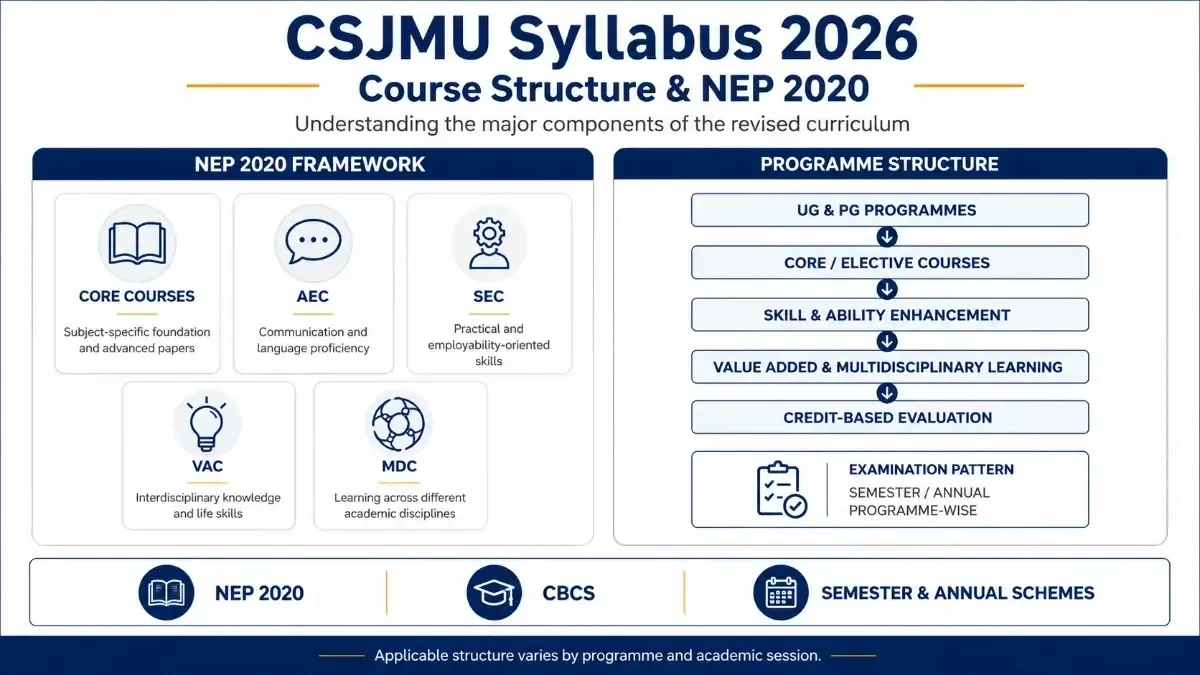
CSJMU Syllabus Pattern under NEP 2020
CSJMU has gradually implemented the National Education Policy (NEP) 2020 across several undergraduate programmes. The framework promotes multidisciplinary learning and a Choice Based Credit System (CBCS), where applicable.
Many undergraduate programmes now follow the semester system under NEP 2020, while some courses continue to follow the annual examination scheme as notified by the university.
| Particular | Details |
| Academic Framework | NEP 2020 |
| Credit System | CBCS |
| Programme Structure | Core, Elective, Skill Enhancement & Value Added Courses |
| Examination Pattern | Semester/Annual (Programme-wise) |
| Applicable Courses | Selected UG & PG Programmes |
Students should therefore download the syllabus specific to their programme and academic session before preparing for examinations.
CSJMU NEP 2020 Implementation Status 2026
Chhatrapati Shahu Ji Maharaj University has been progressively implementing the National Education Policy (NEP) 2020 across its undergraduate and postgraduate programmes. As of the 2025–26 academic session, the university has achieved significant milestones in aligning its curriculum with NEP 2020 guidelines.
| Aspect | Implementation Status |
| Academic Framework | Implemented in selected UG & PG programmes |
| Credit System | CBCS (Choice Based Credit System) adopted |
| Multiple Entry/Exit | Provision available for NEP programmes |
| Skill Enhancement Courses (SEC) | Integrated across faculties |
| Ability Enhancement Courses (AEC) | Mandatory for all NEP programmes |
| Value Added Courses (VAC) | Offered in Commerce, Arts, and Science streams |
| Multidisciplinary Courses (MDC) | Available for cross-faculty learning |
| Vocational Integration | Retail Operations, Logistics, BFSI, E-Commerce, Tourism & Hospitality |
| Internship/Industry Training | Mandatory for professional courses (B.Tech, MBA, B.Pharm) |
| Research & Innovation | Project work and dissertation mandatory for PG programmes |
Courses Under NEP 2020 (2025–26 Session):
According to Bhaskar (April 2, 2026), CSJMU offers admissions to 175 courses in the 2026-27 session, with 18 courses through entrance exams and 157 courses through direct admission. The following faculties have adopted NEP 2020:
- Arts & Social Science: BA, MA (Political Science, Hindi, English, Sanskrit, History, Economics, Geography, Psychology, Public Administration, Sociology, Anthropology, Dramatics, Philosophy, Urdu)
- Commerce: B.Com, B.Com (ABST), B.Com (EAFM), B.Com (Business Administration), BBA, M.Com
- Science: B.Sc, M.Sc (Mathematics, Physics, Chemistry, Botany, Zoology, Biotechnology, Geology, Statistics, Home Science, Computer Applications)
- Education: B.Ed, M.Ed, Special Education, Physical Education, BLIS
- Engineering: Dual Degree B.Tech–M.Tech in Converging Technologies
- Fine Arts & Performing Arts: Bachelor of Design (Communication, Fashion, Interior and Jewellery Design), Music, Kathak
- Law: LLB, LLM
- Professional & Skill-based Courses: Retail Operations, Logistics, E-Commerce Operations, Banking, Financial Services & Insurance (BFSI), Tourism & Hospitality, Human Resource Operations, Event Management
NEP 2020 Key Features at CSJMU:
- Multiple Entry and Exit: Students can enter and exit programmes at different stages with appropriate certifications (Diploma, Advanced Diploma, Degree).
- Credit Transfer: Credits earned at CSJMU can be transferred to other universities under the NEP framework.
- Skill Integration: Vocational courses integrated with mainstream education to enhance employability.
- Multidisciplinary Learning: Students can choose courses from different faculties to broaden their knowledge base.
- Industry Linkages: Mandatory internships and industry projects for professional courses.
- Research Orientation: Emphasis on research methodology, dissertation work, and innovation projects.
CSJMU Academic Calendar 2026-27
The Chhatrapati Shahu Ji Maharaj University follows a structured academic calendar for the 2026-27 academic session. The calendar outlines important dates for classes, examinations, holidays, and other academic activities.
Odd Semester Academic Calendar 2026-27:
According to the official CSJMU Academic Calendar 2026-27 (Odd Semester) document:
| Activity | Timeline |
| Classes Commence | August 2026 |
| Quiz 1 | September 2026 |
| Cultural, Literary and Artistic Events | October–November 2026 |
| Mid-Semester Examinations | October 2026 |
| Quiz 2 | November 2026 |
| End-Semester Examinations | December 2026 – January 2027 |
| Winter Break | December 2026 – January 2027 |
| Result Declaration | February 2027 |
Even Semester Academic Calendar 2026-27:
| Activity | Timeline |
| Classes Commence | January 2027 |
| Quiz 1 | February 2027 |
| Cultural, Literary and Artistic Events | March–April 2027 |
| Mid-Semester Examinations | March 2027 |
| Quiz 2 | April 2027 |
| End-Semester Examinations | April–May 2027 |
| Summer Break | May–June 2027 |
| Result Declaration | June 2027 |
Important Notes:
- Academic Calendar is subject to change based on university notifications.
- Students should regularly check the official CSJMU website for updated academic calendars and examination schedules.
- NEP 2020 programmes may have slightly different academic calendars due to the flexible entry/exit system.
CSJMU FYUP (Four-Year Undergraduate Programme) Syllabus 2026
The Four-Year Undergraduate Programme (FYUP) under NEP 2020 is a key feature of CSJMU's academic reforms. The FYUP allows students to pursue a four-year bachelor's degree with multiple exit options and specialisations.
FYUP Structure:
| Year | Exit Option | Certification |
| Year 1 | Exit after 1 year | Certificate |
| Year 2 | Exit after 2 years | Diploma |
| Year 3 | Exit after 3 years | Bachelor's Degree |
| Year 4 | Complete 4 years | Bachelor's Degree (Honours/Research) |
Benefits of FYUP at CSJMU:
- Flexibility: Multiple entry and exit options allow students to pursue education at their own pace.
- Skill Development: Integration of vocational and skill-based courses enhances employability.
- Research Orientation: Fourth-year students can pursue research projects for Honours/Research degrees.
- Credit Transfer: Credits can be transferred to other universities under NEP framework.
- Industry Readiness: Internships and industry projects prepare students for professional careers.
How to Download CSJMU Syllabus PDF 2026
CSJMU provides syllabus PDFs through its official website, allowing students to access the curriculum applicable to their programme. Students should verify the academic session, semester or year, and applicable NEP or CBCS framework before downloading.
The following steps can be used to access the latest syllabus PDF from the university portal.
Steps to Download CSJMU Syllabus 2026
- Visit the official CSJMU website: https://csjmu.ac.in
- Navigate to the "Decode" or "Students Life/Current Students" section.
- Click on the "Syllabus" link.
- Select the relevant faculty or department.
- Choose your programme and semester/year.
- Download the syllabus PDF for future reference.
The syllabus portal includes curriculum PDFs for undergraduate, postgraduate, diploma, and professional courses across Arts, Commerce, Science, Law, Management, and other disciplines.
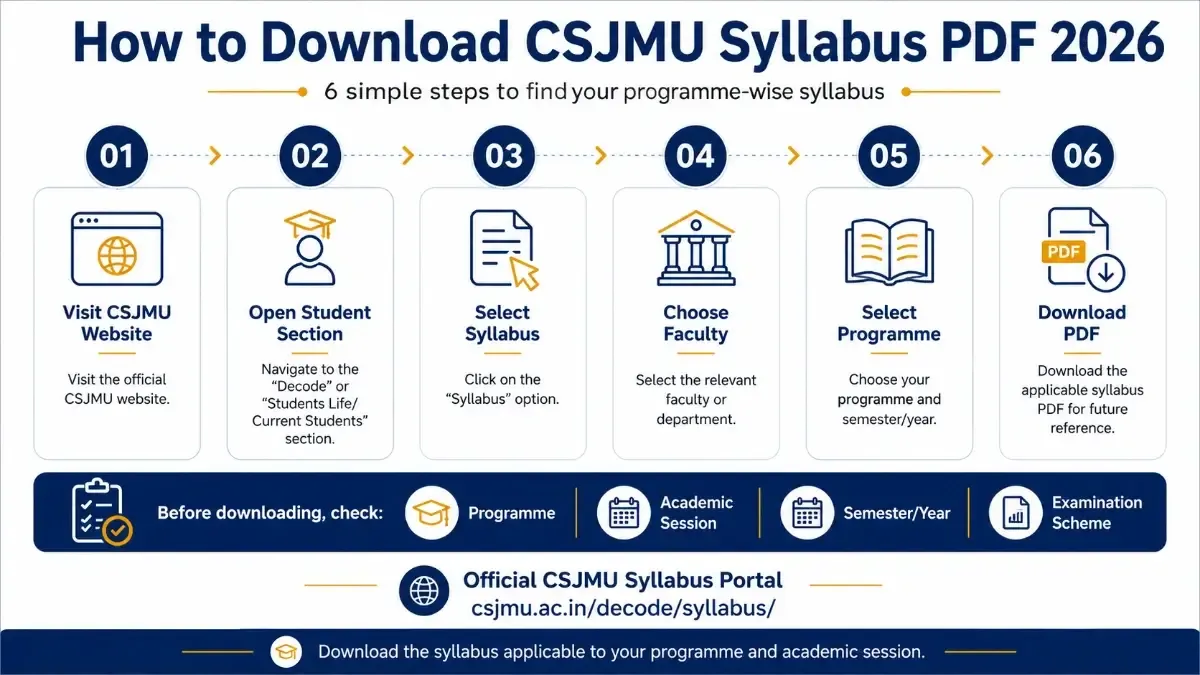
Direct link to download syllabus PDF.
CSJMU Examination Pattern 2026
The CSJMU Examination Pattern 2026 varies according to the programme and examination scheme. According to the cited sources, even-semester examinations for several UG and PG programmes follow an MCQ-based format, while LLB and BA LLB examinations follow a subjective pattern.
The examination schedule and pattern should be checked against the programme-specific notification issued by the university.
| Programme/Exam | Pattern | Duration | Shifts |
| UG/PG Semester Exams (BA, BSc, BCom, MA, MSc, MCom) | MCQ-based | 1.5 hours | Three shifts |
| LLB & BA LLB Exams | Subjective-type | 3 hours | Two shifts |
Exam Period: April 11 – May 15, 2026 (Even Semester 2025–26)
Frequently Asked Questions
How can I download the CSJMU Syllabus PDF 2026?
Students can download the latest CSJMU Syllabus 2026 by visiting the official CSJMU website, navigating to the Decode/Students Life section, clicking on Syllabus, and selecting their faculty, programme, and semester or academic year.
Does CSJMU follow both semester and annual syllabus patterns?
Yes. The Chhatrapati Shahu Ji Maharaj University follows both semester and annual examination schemes, depending on the programme. Many undergraduate courses have adopted the semester system under NEP 2020, while some programmes continue under the annual pattern.
Is the CSJMU syllabus based on NEP 2020?
Yes. Several undergraduate and postgraduate programmes at CSJMU follow the National Education Policy (NEP) 2020 along with the Choice Based Credit System (CBCS), where applicable. The syllabus includes core, elective, skill enhancement, and multidisciplinary courses.
Which courses are covered under the CSJMU Syllabus 2026?
The Chhatrapati Shahu Ji Maharaj University publishes syllabus PDFs for a wide range of programmes, including BA, BSc, BCom, MA, MSc, MCom, LLB, LLM, MBA, BBA, Political Science, Hindi, English, Commerce, Science, and other diploma and professional courses.
Is the CSJMU BA Political Science Syllabus 2026 available in both English and Hindi?
Yes. The BA Political Science syllabus is available in both English and Hindi and can be downloaded from the official CSJMU syllabus portal.
What subjects are included in the CSJMU BA Political Science Syllabus 2026?
The BA Political Science syllabus generally covers topics such as Political Theory, Indian Government and Politics, Comparative Politics, Public Administration, International Relations, Political Sociology, Human Rights, and Contemporary Political Issues, depending on the semester or annual scheme.
Does CSJMU update its syllabus every academic session?
Yes. The Chhatrapati Shahu Ji Maharaj University releases the latest syllabus before the start of each academic session. Students should always refer to the syllabus applicable to their programme, semester, and academic year.
What details are included in the CSJMU syllabus?
The syllabus typically includes the course structure, subject-wise units, credit distribution, practical components (where applicable), internal assessment, examination pattern, and recommended reading materials.

fits you best?
Get personalized guidance from our admission counselors