


Table of Contents
About Central Institute of Buddhist Studies
Campus & Infrastructure
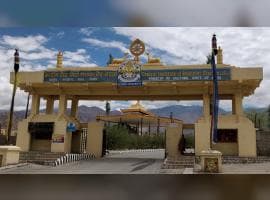
The Central Institute of Buddhist Studies is located in Choglamsar, 8 km south of Leh town, on the bank of the Indus River. The institute operates out of two campuses: the new and the old.
Location Details
| Parameter | Details |
|---|---|
| City | Leh |
| State | Jammu and Kashmir |
| Address | Choglamsar, Leh, Ladakh – 194101 |
Facilities
- Library with over 38,000 books, 30+ subscribed national & international journals, and 200+ volumes of rare xylography of Bhoti texts
- Digital library section with computer systems and internet connection
- Computer labs
- Canteen serving hygienic food at affordable prices
- Sports facilities, including space for indoor and outdoor games like Volleyball, Football, Cricket, Handball, Table Tennis, Chess, and Carom
- Medical facility
- Transportation facility
- Museum with a collection of antiquities and regional objects-de-art
- IT infrastructure resources
Hostel
The Central Institute of Buddhist Studies has three well-furnished, spacious, and clean hostels with a capacity of 100 students in each, named after renowned Buddhist academics. The hostels are available for monks, girls-nuns, and boys coming from far away locations, and provide mess facilities with excellent cooks serving delicious and healthy food.
For the full fee list by course, see Central Institute of Buddhist Studies courses and fees.
Scholarships & Financial Aid
The Central Institute of Buddhist Studies, Leh offers scholarships and financial aid to eligible candidates based on merit and need.
College Scholarships
| Scholarship | Eligibility | Benefit |
|---|---|---|
| CIBS Leh Scholarships | Students studying in Gonpa schools grades 6th to 8th, grades 9 students through Shastri, students studying in Acharya and interns at Sowa-Rigpa | Stipends |
| Mert-Based Scholarships | Mert students | Scholarships provided by the institute |
Government Schemes
Students may also apply for state/central government scholarships like NSP, state minority scholarships, etc. The institute annually disburses INR 161.62 lakhs towards student stipend, merit scholarship and research fellowship.
Central Institute of Buddhist Studies Courses and Fees 2026
| Degree | Duration | Annual Fee | Seats | Eligibility | Action |
|---|---|---|---|---|---|
Bachelor of Arts1 Specialization | 3 Years | ||||
Certificate6 Specializations | 6 Years | ||||
Diploma2 Specializations | 6 Months | ||||
Master of Arts1 Specialization | 2 Years | ||||
Ph.D5 Specializations | 3 Years |
Central Institute of Buddhist Studies Rankings
Accreditations
AIU
DEB

University Grants Commission
Central Institute of Buddhist Studies Campus Gallery
Nearest Attractions at Central Institute of Buddhist Studies


Nearby Locations

Kushok Bakula Rimpochee Airport (IXL), Leh
8.5000000000000000 km

Leh Bus Stand
11.0000000000000000 km

Sonam Norboo Memorial (SNM) Hospital, Leh
13.5000000000000000 km
Facilities Provided by Central Institute of Buddhist Studies
- Classrooms
- Lecture Halls
- Seminar Rooms
- Clean Drinking Water Facilities
- Electricity Backup
- Stationery Shop
- Access Control System (Manual)
- Campus Cafeteria/Canteen
- Hostel Mess Facilities
- Boys'' Hostel
- Girls'' Hostel
- Central Computer Center
- Wi-Fi Enabled Campus
- Computer Lab
- Language Lab
- Central Library
- Digital Library Section
- Rare Manuscript Collection
- Spacious Reading Rooms
- First Aid and Basic Health Center
- Hostel Common Rooms
- CCTV Surveillance System
- Gated Campus with Boundary Wall
- Security Guards
- Outdoor Playground/Sports Ground
- Academic Counseling Services
- Grievance Redressal Cell
- Parking Facilities
Student Reviews & Testimonials
Great Initiative of govt. Of India
A deem to be university. An excellent institution for Buddhist philosophy studies. Offering degrees diplomas in Buddhist philosophy mainly Tibetan Buddhism. Tibetan medicine, painting wood curving,astrology sculpture and many more.
Prior to 1959, Ladakhi scholars, novices and monks used to go to Tibet in pursuit of higher monastic Buddhist education, and to do research for years in the famous Mahaviharas of Drepung, Sera, Tashi Lhunpo, Gaden, Sakya, Sangag Chosling, Dege, Drigung and other monastic centres. In the 1950s, this practice came to an abrupt end because of the political situation in Tibet. Hence, it was held imperative that a Buddhist institute should be established for formal Buddhist education in Ladakh. According to archival sources, when the Government of India was organizing the celebration of the 2500th birth anniversary of Gautama Buddha in 1955, Bakula Rinpoche led an official delegation to Tibet, and on his return had a three-hour meeting with the Indian Prime Minister, Pandit Jawaharlal Nehru. At this meeting, Bakula Rinpoche gave a detailed account of the situation in Tibet, including the fact that Ladakhis could no longer travel there to pursue their religious education. He underlined the need for ensuring similar opportunities in Ladakh. Accordingly, the Central Institute of Buddhist Studies was established with the holy rituals performed by Skyabje Ling Rinpoche, the senior tutor of the 14th Dalai Lama. The institute was initially called the “School of Buddhist Philosophy”. Leh was chosen as the centre for the dissemination of Buddhist culture and philosophy in view of its geographical suitability and traditional matrix. In 1962, at Kushok Bakula Rinpoche’s urging, Prime Minister Nehru was fully persuaded of the necessity for such an institution for the Buddhists living in the Himalayas. Thus the institution was given full accreditation with regard to financial support and came under the administrative charge of the Ministry of Culture, Govt. of India. In its initial stages, the institute admitted ten monks, one each from ten monasteries in Ladakh. Two teachers were appointed to instruct the students in Tibetan literature and Buddhist philosophy. The first Principal of the institute (1959 – 1967) was a renowned Tibetan Buddhist scholar, Ven. Yeshi Thupstan. For three years these ten monasteries bore the entire expenses of the students and the teachers. From 1959 to 1961 the institute was in Leh. From there it was moved to Spituk village, about 8 km away from Leh, in 1962. The School of Buddhist Philosophy was registered as an educational institution in the year 1964, under the J&K Societies Registration Act of 1941. In 1973 new buildings for the institute were constructed in Choglamsar, 8 km south-east of Leh. Sanskrit, Hindi, English and Pali languages were introduced, in addition to the teaching of Buddhist philosophy and Tibetan literature. In the same year the institute was affiliated to Sampurnanand Sanskrit University, Varanasi (U.P.), and courses suitable for students of the frontier region were introduced.
Well Located and planned institute for people interested in Buddhist Studies new International Centre is also coming up.
Get personalized guidance from our admission counselors
FAQs on Central Institute of Buddhist Studies
When was the Central Institute of Buddhist Studies established?
The Central Institute of Buddhist Studies was established in 1959.
Where is the Central Institute of Buddhist Studies located?
The Central Institute of Buddhist Studies is located in Leh, Jammu and Kashmir.
What type of institution is the Central Institute of Buddhist Studies?
The Central Institute of Buddhist Studies is a deemed university under the Ministry of Culture.
What courses are offered by the Central Institute of Buddhist Studies?
The Central Institute of Buddhist Studies offers various courses, including UG, PG, Ph.D, and Certificate programs in subjects like Sanskrit, Buddhist philosophy, Tibetan literature, Traditional Medicine, and Fine Arts.
What is the library of the Central Institute of Buddhist Studies called?
The library of the Central Institute of Buddhist Studies is called the Sherab Gyasched Tasal Library.
How many books are there in the library of the Central Institute of Buddhist Studies?
The library of the Central Institute of Buddhist Studies has more than 38,000 books.
Is the Central Institute of Buddhist Studies approved by UGC?
Yes, the Central Institute of Buddhist Studies is approved by the University Grants Commission (UGC).
What is the affiliation status of the Central Institute of Buddhist Studies?
The Central Institute of Buddhist Studies was formerly affiliated to the Sampurnanand Sanskrit University in Varanasi, but it is now a deemed university.
What is the NAAC grade of the Central Institute of Buddhist Studies?
The Central Institute of Buddhist Studies has been graded 'A' by the National Assessment and Accreditation Council (NAAC).
Discover More Colleges







fits you best?
Get personalized guidance from our admission counselors