The CUET Accountancy syllabus 2026 plays a crucial role for students preparing for the CUET UG exam. The CUET accounts syllabus is mainly based on the NCERT Class 12 Accountancy curriculum, making conceptual clarity and regular practice essential for scoring well. Candidates appearing for the CUET exam 2026 should carefully understand the unit-wise topics, exam structure, and important chapters included in the syllabus. The CUET Accountancy 2026 exam will be conducted between May 11 and May 31, 2026, consisting of 50 multiple-choice questions (MCQs) with a duration of 60 minutes. Conducted by the National Testing Agency (NTA), the exam covers key areas such as Accounting for Non-Profit Organisations, Partnership Firms, Company Accounts, Financial Statement Analysis, and Automated Accounting Systems, helping students secure admission to undergraduate commerce courses like B.Com and B.Com (Hons.).
Table of Contents
CUET Accountancy Syllabus 2026 Overview
Before starting preparation, students should understand the basic details of the CUET Accountancy syllabus 2026, including exam timelines, conducting authority, and syllabus structure. Knowing these details helps candidates plan their preparation effectively and stay updated with important exam-related events during the CUET UG admission process.
| Parameter | Details |
| Entrance Exam | Common University Entrance Test (CUET UG) |
| Year | 2026 |
| Conducting Body | National Testing Agency (NTA) |
| Subject | Accountancy |
| Official Website | cuet.nta.nic.in |
| Application Start Date | February 2026 (Expected) |
| Exam Dates | May 11 to May 31, 2026 |
| Result Date | June 2026 (Expected) |
| Exam Mode | Computer-Based Test (CBT) |
| Level | Class 12 |
| Medium | Multiple Languages |
| Total Marks | 250 Marks |
| Syllabus Basis | NCERT Class 12 Accountancy Curriculum |
| Syllabus Structure | Major units covering Partnership, Company Accounts, and Financial Analysis |
| Important Topics | Partnership Firms, Company Accounts, Financial Statements, Accounting Ratios, Cash Flow |
| Eligibility | Students appearing for Class 12 exams in 2026 |
| Selection Process | CUET score-based merit list, document verification, and admission by universities |
| Previous Year Papers Available | 2022, 2023, 2024, 2025 |
| Recommended Books | T.S. Grewal, D.K. Goel, Accounting Made Easy, R. Srinivasan |
The CUET Accountancy syllabus is designed to evaluate students’ understanding of accounting principles, financial statements, partnership accounting, and company accounts. Candidates should regularly check official notifications and follow a structured preparation plan to perform well in CUET 2026.
CUET Accountancy 2026 Important Dates: Application, Exam & Result
Students preparing for CUET Accountancy 2026 should stay updated with all official timelines to avoid missing important deadlines. The CUET UG 2026 exam, conducted by the National Testing Agency, is expected to be held in May 2026, with the application process likely beginning in February 2026.
Candidates are advised to regularly check the official CUET portal — CUET Official Website — for the latest updates on the CUET UG 2026 Accountancy exam schedule.
| Event | Date | Status |
| CUET 2026 Notification Release | December 27, 2025 | Released |
| Application Form Start Date | January 3, 2026 | Completed |
| Last Date to Apply | February 26, 2026 (Extended) | Completed |
| Application Correction Window | February 9 – February 11, 2026 | Completed |
| Reopened Application Window | February 23 – February 26, 2026 | Completed |
| City Intimation Slip Release | First Week of May 2026 | Expected |
| Admit Card Release | First Week of May 2026 | Expected |
| CUET Accountancy Exam Date | May 11 – May 31, 2026 | Scheduled |
| Provisional Answer Key Release | Third Week of June 2026 | Expected |
| Final Answer Key Release | June–July 2026 | Expected |
CUET Accountancy Exam Pattern 2026: Questions, Marking Scheme & Duration
Understanding the CUET Accountancy exam pattern 2026 is essential for managing time effectively and scoring well. The exam follows a standardized format used across CUET UG domain subjects, making it important for candidates to understand the marking system and question structure before attempting mock tests.
The CUET Accountancy paper consists of multiple-choice questions based on the NCERT Class 12 Accountancy syllabus, covering topics such as Partnership Accounts, Company Accounts, Financial Statement Analysis, and Automated Accounting Systems.
| Parameter | Details |
| Subject | Accountancy |
| Question Type | Multiple Choice Questions (MCQs) |
| Total Questions | 50 Questions |
| Questions to Attempt | 50 Questions (All Mandatory) |
| Duration | 60 Minutes |
| Marks per Question | 5 Marks |
| Negative Marking | −1 Mark for incorrect answer |
| Unanswered Questions | No negative marking |
| Total Marks | 250 Marks |
| Exam Mode | Computer-Based Test (CBT) |
| Difficulty Level | Moderate |
Important Topics Covered in CUET Accountancy Exam
Although the exam does not divide questions into fixed sections, the following major areas are commonly included in the CUET accounts syllabus:
- Accounting for Not-for-Profit Organisations
- Partnership Accounts
- Accounting for Share Capital
- Issue and Redemption of Debentures
- Financial Statement Analysis
- Accounting Ratios
- Cash Flow Statement
- Automated Accounting System
These topics form the core foundation of the CUET Accountancy syllabus 2026, and students should allocate more revision time to them.
CUET Accountancy Syllabus 2026: Unit-Wise Topics
The CUET Accountancy Syllabus 2026 is based primarily on the NCERT Class 12 Accountancy curriculum and is designed to evaluate students’ understanding of partnership accounting, company accounts, and financial statement analysis. Candidates preparing for CUET UG 2026 should focus on conceptual clarity and regular numerical practice, as most questions test calculation accuracy and accounting logic.
According to the official syllabus released by the National Testing Agency, the CUET Accountancy syllabus is divided into three major units with multiple subtopics under each section.
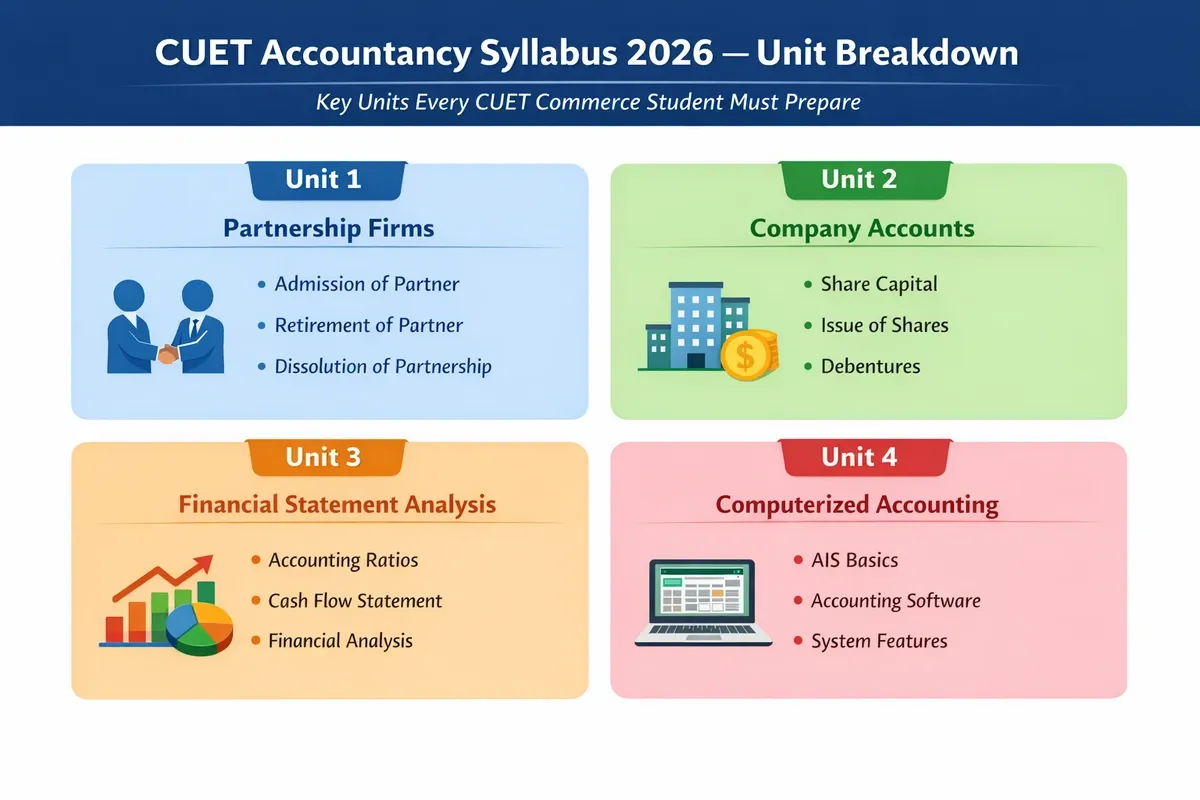
| Unit No. | Unit Name | Key Areas Covered | Preparation Priority |
| Unit 1 | Accounting for Partnership Firms | Admission, Retirement, Dissolution, Goodwill, Capital Accounts | ⭐⭐⭐⭐⭐ High |
| Unit 2 | Accounting for Companies | Share Capital, Debentures, Issue & Redemption | ⭐⭐⭐⭐ High |
| Unit 3 | Analysis of Financial Statements | Ratios, Cash Flow, Financial Analysis | ⭐⭐⭐⭐ High |
Unit 1: Accounting for Partnership Firms
This is one of the most important units in the CUET Accountancy syllabus 2026, as it includes multiple numerical-based questions and adjustment entries. Students preparing for CUET UG Accountancy 2026 should practice partnership-related calculations extensively.
Key Topics in Partnership Firms
Fundamentals of Partnership
- Meaning and features of partnership
- Partnership deed
- Provisions of Partnership Act
- Profit-sharing ratio
- Fixed and fluctuating capital accounts
- Interest on capital
- Interest on drawings
- Salary and commission to partners
- Guarantee of profit to partners
Change in Profit-Sharing Ratio
- Meaning of sacrificing ratio
- Gaining ratio calculation
- Accounting treatment of goodwill
- Revaluation of assets and liabilities
- Adjustment of accumulated profits and losses
Admission of a Partner
- Accounting treatment of goodwill
- Revaluation account preparation
- Adjustment of capital accounts
- Calculation of new profit-sharing ratio
- Preparation of revised balance sheet
Retirement or Death of a Partner
- Calculation of gaining ratio
- Treatment of goodwill
- Settlement of dues
- Adjustment of reserves
- Capital account preparation
Dissolution of Partnership Firm
- Meaning and process of dissolution
- Preparation of Realisation Account
- Settlement of liabilities
- Distribution of assets
Preparation Tip: Practice past adjustment questions, goodwill calculations, and revaluation entries, as these frequently appear in CUET Accountancy mock tests.
Unit 2: Accounting for Companies
The Company Accounts unit focuses on accounting procedures related to share capital and debentures. This section requires strong conceptual clarity and familiarity with journal entries.
Key Topics in Company Accounts
Accounting for Share Capital
- Meaning and types of shares
- Issue of shares
- Share forfeiture
- Reissue of forfeited shares
- Over-subscription and under-subscription
- Calls in arrears
- Calls in advance
Issue and Redemption of Debentures
- Meaning of debentures
- Types of debentures
- Issue of debentures
- Redemption of debentures
- Writing off discount or loss
Preparation Tip: Focus on journal entries, ledger preparation, and numerical adjustments, especially from NCERT examples.
Download the CUET Accountancy Syllabus PDF here.
Unit 3: Analysis of Financial Statements
This unit tests students’ ability to analyze financial data and interpret accounting results. Compared to other units, this section involves analytical reasoning rather than heavy calculations.
Key Topics in Financial Statement Analysis
Financial Statements of a Company
- Meaning and importance
- Statement of Profit and Loss
- Balance Sheet
- Major headings and subheadings
Financial Statement Analysis
- Objectives of financial analysis
- Tools of financial analysis
- Comparative statements
- Common-size statements
Accounting Ratios
- Liquidity ratios
- Solvency ratios
- Activity ratios
- Profitability ratios
Cash Flow Statement
- Meaning and preparation
- Operating activities
- Investing activities
- Financing activities
Preparation Tip: Students should practice ratio calculations and cash flow statement preparation, as these are common in CUET UG Accountancy questions.
Unit 4: Computerized Accounting System
This unit focuses on the fundamentals of computerized accounting and accounting information systems. Compared to other units, this section is theory-based and requires conceptual understanding rather than extensive calculations.
Key Topics in Computerized Accounting System
- Meaning of Computerized Accounting System
- Components of Accounting Information System (AIS)
- Advantages of Computerized Accounting
- Features of Computerized Accounting
- Structure of Computerized Accounting System
- Comparison between Manual and Computerized Accounting
Preparation Tip: Revise definitions and system features regularly, as questions from this unit are typically theory-based and scoring.
Important Highlights of CUET Accountancy Syllabus 2026
Below are the most important syllabus insights every candidate preparing for CUET UG 2026 Accountancy should know:
- Based mainly on Class 12 NCERT Accountancy
- Includes three major units
- Focuses on numerical and conceptual accounting skills
- Covers real-world accounting applications
- Requires strong practice of journal entries and financial statements
How the CUET Accountancy Syllabus Helps in Exam Preparation
Understanding the CUET Accountancy syllabus 2026 allows candidates to:
- Identify important chapters
- Prioritize high-weightage units
- Plan a structured revision schedule
- Improve accuracy in numerical problems
- Strengthen time management skills
Students preparing for CUET UG Accountancy 2026 should regularly solve previous year question papers and attempt mock tests to strengthen conceptual understanding and improve exam performance.
CUET Accountancy 2026 Eligibility Criteria: Age, Qualification & Attempts
Students planning to appear for CUET Accountancy 2026 must meet the eligibility conditions specified by the National Testing Agency. The eligibility rules mainly focus on educational qualification and subject selection rather than strict age restrictions.
Understanding the CUET Accountancy eligibility criteria 2026 ensures that candidates select the correct domain subject and prepare according to the CUET UG syllabus requirements.
| Criteria | Details |
| Exam Name | CUET UG 2026 |
| Conducting Body | National Testing Agency (NTA) |
| Age Limit | No specific age limit prescribed by NTA |
| Minimum Qualification | Must have passed or be appearing in Class 12 or equivalent examination |
| Subject Requirement | Students should have studied Accountancy in Class 12 to choose Accountancy in CUET |
| Number of Attempts | No restriction on the number of attempts |
| Minimum Marks Requirement | Varies by university and course requirements |
| Eligibility Authority | Final eligibility is determined by individual participating universities |
| Official Website | cuet.nta.nic.in |
CUET Accountancy Syllabus 2026 vs Class 12 Board Syllabus
The CUET Accountancy syllabus 2026 is largely aligned with the Class 12 Accountancy board syllabus, making it easier for students preparing for board exams to simultaneously prepare for CUET UG 2026. Most questions in the CUET Accountancy exam are based on conceptual understanding and numerical problems from the NCERT Class 12 Accountancy curriculum recommended by the National Council of Educational Research and Training.
Understanding the similarities between the CUET Accountancy syllabus and the Class 12 board syllabus helps students plan their preparation efficiently and avoid unnecessary extra study material.
| Parameter | CUET Accountancy Syllabus 2026 | Class 12 Board Accountancy Syllabus |
| Overall Alignment | Highly similar to Class 12 syllabus | Serves as the foundation for CUET syllabus |
| Syllabus Source | Mainly based on NCERT Class 12 Accountancy | Fully based on NCERT Class 12 curriculum |
| Major Units Covered | Partnership Firms, Company Accounts, Financial Statement Analysis | Partnership Firms, Company Accounts, Financial Statements |
| Key Topics | Admission, Retirement, Dissolution, Share Capital, Debentures, Ratios, Cash Flow | Same core topics taught during board preparation |
| Computerized Accounting (AIS) | Included as a unit in CUET syllabus | Covered in most board syllabi |
| Exam Pattern | Objective-type MCQs (50 questions) | Mix of theory and numerical questions |
| Preparation Strategy | Focus on MCQ practice and calculations | Focus on written answers and numerical solutions |
| Difficulty Level | Moderate | Moderate to High (subjective writing included) |
| Syllabus Changes (2026) | No major changes officially announced | No major changes reported |
CUET Accountancy Previous Year Analysis: Important Topics & Difficulty Trends
Analyzing CUET Accountancy previous year questions (PYQs) helps candidates understand the most frequently asked topics and the overall difficulty level of the exam. Based on trends from recent CUET UG exams, most questions are derived directly from the NCERT Class 12 Accountancy syllabus, with a strong focus on conceptual clarity and numerical problem-solving.
Understanding past trends allows students preparing for CUET Accountancy 2026 to prioritize important chapters and improve their exam strategy.
| Unit | Frequently Asked Topics | Observed Difficulty Level | Preparation Priority |
| Accounting for Partnership Firms | Admission, Retirement, Dissolution, Goodwill, Revaluation | Moderate to Difficult | ⭐⭐⭐⭐⭐ High |
| Company Accounts | Issue of Shares, Debentures, Share Capital | Moderate | ⭐⭐⭐⭐ High |
| Financial Statement Analysis | Accounting Ratios, Comparative Statements | Moderate | ⭐⭐⭐⭐ High |
| Cash Flow Statement | Operating, Investing, Financing Activities | Moderate | ⭐⭐⭐⭐ High |
| Not-for-Profit Organisations | Income & Expenditure Account, Receipts & Payments | Easy to Moderate | ⭐⭐⭐ Medium |
| Computerized Accounting System (AIS) | Basic Concepts of Computerized Accounting | Easy | ⭐⭐ Medium |
CUET Accountancy Difficulty Level Trends
Based on recent CUET exams, the overall difficulty level of the Accountancy paper is generally:
| Year | Overall Difficulty | Remarks |
| CUET 2022 | Moderate | Concept-based questions |
| CUET 2023 | Moderate | Balanced numerical and theory |
| CUET 2024 | Moderate to Slightly Difficult | More application-based questions |
| CUET 2025 | Moderate | Similar to NCERT examples |
Most questions are directly based on NCERT concepts, making textbook revision extremely important.
Most Important Topics Based on PYQ Analysis
Students preparing for CUET Accountancy 2026 should focus more on the following high-priority topics:
- Partnership Admission and Retirement
- Dissolution of Partnership Firms
- Share Capital Accounting
- Issue and Redemption of Debentures
- Accounting Ratios
- Cash Flow Statement
- Revaluation of Assets and Liabilities
- Goodwill Adjustment
These topics frequently appear in CUET Accountancy previous year papers.
How to Prepare for CUET Accountancy 2026
A structured preparation plan is essential to cover the CUET Accountancy syllabus effectively.
Preparation Strategy
- Understand the Complete Syllabus
Start preparation by reviewing the CUET UG Accountancy syllabus thoroughly. Divide topics into smaller sections and set realistic goals.
- Focus on NCERT Books
The CUET accounts syllabus is mainly based on NCERT Class 12 Accountancy.
Students should:
- Read each chapter carefully
- Solve all examples
- Practice end-of-chapter questions
NCERT remains the most important resource for the CUET exam.
- Practice Numerical Questions Regularly
Accountancy requires regular practice.
Students should:
- Solve numerical problems daily
- Revise formulas and formats
- Practice journal entries
Consistent practice improves accuracy.
- Revise High-Weightage Topics
Prioritize important chapters such as:
- Admission of Partner
- Retirement of Partner
- Cash Flow Statement
- Accounting Ratios
These topics are commonly asked in the CUET UG exam.
- Attempt Mock Tests
Mock tests help:
- Improve speed
- Identify weak areas
- Build confidence
Attempting previous year CUET questions is highly recommended.
Best Books for CUET Accountancy Preparation
Choosing the right books is essential for mastering the CUET accounts syllabus.
Recommended Books
- NCERT Class 12 Accountancy (Part 1 & 2)
- TS Grewal Accountancy Book
- DK Goel Accountancy Book
- Oswal CUET Accountancy Question Bank
These books provide concept clarity and practice questions.
Frequently Asked Questions
The CUET Accountancy syllabus 2026 includes major topics such as Partnership Accounting, Company Accounts, Financial Statement Analysis, Accounting Ratios, and Cash Flow Statements. The syllabus is mainly based on the Class 12 NCERT Accountancy curriculum.
Yes, the CUET Accountancy syllabus is largely based on the NCERT Class 12 Accountancy syllabus, making NCERT textbooks the most important study resource.
- Admission of Partner
- Retirement of Partner
- Dissolution of Partnership Firm
- Share Capital
- Debentures
- Accounting Ratios
- Cash Flow Statement
These topics are frequently seen in previous year papers.
- 50 Multiple Choice Questions (MCQs)
- Duration: 60 Minutes
- Marks: +5 for correct answers
- Negative Marking: −1 for incorrect answers
Students can download the CUET Accountancy syllabus PDF from the official website of the National Testing Agency by visiting the CUET UG syllabus section.
The difficulty level of CUET Accountancy is generally moderate. Students who regularly practice numerical problems and revise NCERT concepts usually find the paper manageable.
- Study NCERT books thoroughly
- Practice numerical problems daily
- Revise formulas regularly
- Solve previous year papers
- Attempt mock tests weekly
- Accounting Made Easy — Rajesh Agrawal
- NCERT Class 12 Accountancy Textbooks
- Practice books based on CUET previous year papers
Yes, students who choose Accountancy as a domain subject in CUET can apply for B.Com and B.Com (Hons.) programs offered by universities accepting CUET scores.