Lakhs of students apply and compete every year for the limited seats available in top universities. This makes preparation for CUET exam 2026 crucial. It requires a clear strategy, strong conceptual understanding, and regular practice. When a structured CUET preparation plan is followed, it makes it easier to achieve high scores and secure admission in desired colleges.
The Common University Entrance Test (CUET) includes Language Tests, Domain Subjects, and the General Test, making it important for candidates to focus on multiple areas simultaneously. A successful preparation strategy includes understanding the syllabus, selecting the right CUET preparation books, practicing mock tests, and revising regularly.
Since most questions in the CUET exam come directly from 11th and 12th NCERT textbooks, experts have repeatedly recommended starting the preparation with these books. Around 60–70% of CUET questions are derived from repeated NCERT concepts, making conceptual clarity extremely important for achieving a high score. This detailed guide explains how to prepare for CUET exam 2026, subject-wise strategies, study plans, preparation books, and expert tips.
Table of Contents
Why CUET Preparation is Important
The CUET exam is one of the most competitive entrance exams for undergraduate admissions in India. Universities such as Delhi University and other central institutions use CUET scores as the primary admission criterion.
Proper preparation helps candidates:
- Understand the CUET exam pattern
- Cover the complete syllabus effectively
- Improve time management skills
- Increase accuracy and speed
- Achieve higher scores and rank
A well-planned strategy ensures students stay focused and avoid last-minute confusion during the preparation phase.
CUET Exam Pattern Overview for Preparation
Before starting CUET preparation, students must understand the exam structure.
CUET Exam Sections
The CUET exam generally consists of:
- Language Test
- Domain Subjects
- General Test
Each section requires different preparation methods. The table below highlights the major CUET exam sections along with the topics included in each.
| Section | Topics Included | Preparation Tip |
| Language Test | Reading comprehension, Vocabulary, Grammar, Sentence correction, Verbal ability | Reading comprehension contributes significantly to the language section score, so daily reading practice is highly recommended. |
| Domain Subjects | Physics, Chemistry, Mathematics, Biology, Accountancy, Economics, History, Political Science | Most questions are directly based on NCERT syllabus, so mastering the books is crucial for strong performance. |
| General Test (GT) | Quantitative aptitude, Logical reasoning, General knowledge, Current affairs | Daily practice of reasoning and arithmetic topics improves accuracy and performance in the General Test section. |
Understanding the structure of CUET exam sections helps candidates plan their preparation effectively and focus on the subjects most relevant to their chosen course.
How to Start CUET Preparation 2026
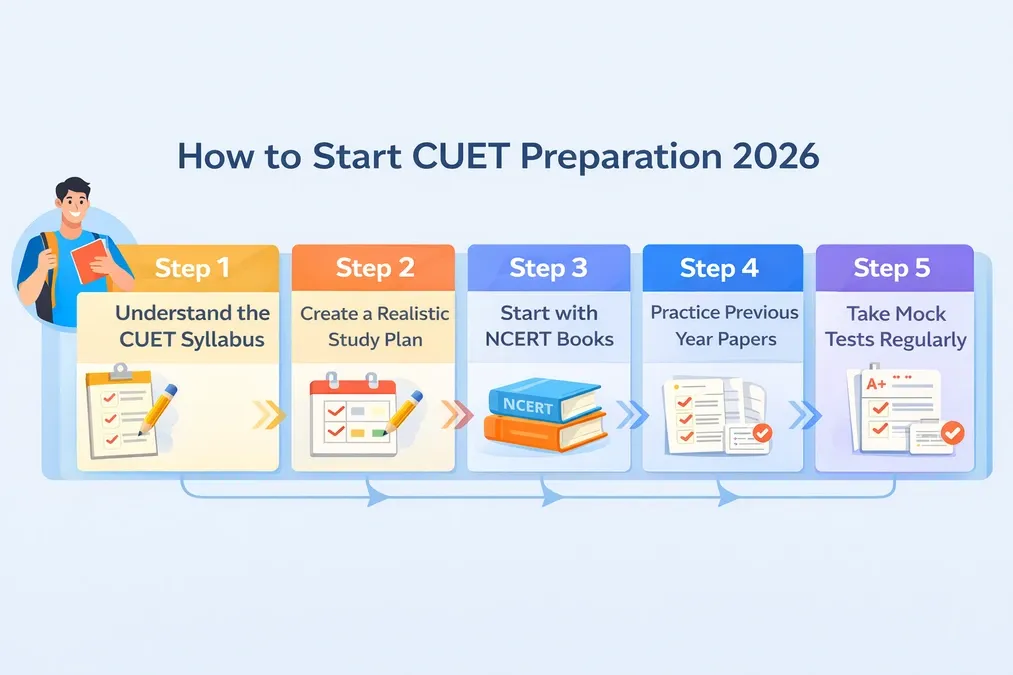
Many students feel confused about how to begin preparation. The best approach is to follow a structured sequence.
Step 1: Understand the CUET Syllabus
Download the official syllabus and:
- Identify important topics
- Mark high-weightage chapters
- Note subject combinations
Starting preparation without understanding the syllabus leads to wasted effort and confusion.
Step 2: Create a Realistic Study Plan
A timetable helps maintain consistency.
Key features of a good timetable:
- Fixed daily study hours
- Balanced subject distribution
- Weekly revision slots
- Mock test days
Creating a timetable is one of the most recommended steps in CUET preparation strategy.
Step 3: Start with NCERT Books
Experts strongly recommend focusing on NCERT textbooks before using other resources.
Why this matters:
- Covers most exam topics
- Explains concepts clearly
- Matches CUET syllabus closely
- Helps build strong fundamentals
NCERT-first preparation significantly improves conceptual understanding and exam performance.
Step 4: Practice Previous Year Papers
Previous year papers help:
- Understand exam difficulty
- Identify repeated topics
- Improve speed
- Reduce exam fear
Students who regularly practice past papers develop better confidence and accuracy.
Step 5: Take Mock Tests Regularly
Mock tests simulate real exam conditions.
Recommended approach:
- Start sectional tests early
- Gradually attempt full-length mocks
- Analyse mistakes carefully
Mock test analysis is essential because it highlights weak areas and improves performance over time.
CUET Preparation Strategy for Beginners
Students starting preparation for the CUET exam 2026 should focus on building fundamentals before attempting advanced-level practice.
Beginner Strategy Plan
Month 1–2: Foundation Stage
Focus on:
- NCERT reading
- Basic concepts
- Important formulas
- Short notes
Goal: Build a strong conceptual base.
Month 3–4: Practice Stage
Focus on:
- Topic-wise MCQs
- Mixed practice
- Revision
Goal: Improve problem-solving skills.
Month 5–6: Testing Stage
Focus on:
- Mock tests
- Speed improvement
- Error analysis
Goal: Improve accuracy and confidence.
CUET Preparation Study Plan 2026
A structured study plan helps candidates cover the syllabus efficiently.
Daily Study Plan Example
If studying 3–4 hours daily
- 2 hours – Domain subjects
- 30 minutes – Language practice
- 45 minutes – General Test
- 15 minutes – Revision
Consistency in daily preparation improves long-term retention and performance.
CUET Preparation Timetable (Sample Weekly Plan)
Monday – Friday
- Study Domain Subjects
- Practice MCQs
- Revise previous topics
Saturday
- Sectional Test
- Performance analysis
Sunday
- Revision
- Weak topic practice
Regular revision helps students retain important concepts effectively.
High-Weightage Topics for CUET Preparation
Understanding important topics improves preparation efficiency. The table below highlights the key areas that require consistent practice and conceptual clarity.
| Section | Important Topics | Preparation Tip |
| Language Section | Reading comprehension, Vocabulary, Synonyms & antonyms, Grammar rules | Reading comprehension alone contributes significantly to language section marks, so daily reading practice is highly recommended. |
| General Test | Percentages, Ratio & proportion, Time & work, Logical reasoning, Current affairs | Regular newspaper reading improves vocabulary and awareness of current events, helping in both reasoning and general knowledge. |
| Domain Subjects | Concept-based chapters, Numerical problems, Frequently repeated topics | Concept clarity is more important than memorisation, especially for solving numerical and application-based questions. |
Focusing on these section-wise preparation areas helps candidates build strong fundamentals and improves overall performance in the CUET exam.
CUET Subject-Wise Preparation Strategy 2026
Preparing subject-wise is one of the most effective methods to improve performance in the CUET exam 2026. Since the exam consists of Language, Domain Subjects, and General Test, each section requires a different preparation approach. A targeted strategy ensures better accuracy and time management during the exam.
CUET English Preparation Strategy
The English or Language section in the CUET exam tests comprehension ability, vocabulary, and grammar knowledge. This section can be highly scoring if practiced regularly.
Important Topics for CUET English Preparation
Focus on:
- Reading comprehension
- Vocabulary
- Synonyms and antonyms
- Sentence correction
- Error detection
- Para jumbles
- Fill in the blanks
- Grammar rules
Reading comprehension usually carries significant weightage, so developing reading speed is essential.
Tips for CUET English Preparation
- Read newspapers or editorials daily
- Practice unseen passages regularly
- Learn 10–15 new words daily
- Revise grammar rules weekly
- Solve mock tests to improve speed
Daily reading improves vocabulary, comprehension, and accuracy simultaneously.
CUET General Test Preparation Strategy
The General Test (GT) includes aptitude, reasoning, and general awareness topics. Many students find this section challenging due to its diverse syllabus.
Important Topics for General Test
Focus on:
Quantitative Aptitude
- Percentages
- Ratio and proportion
- Profit and loss
- Time and work
- Average
- Simple and compound interest
- Data interpretation
Logical Reasoning
- Coding-decoding
- Blood relations
- Direction sense
- Series completion
- Syllogism
- Analogy
General Knowledge & Current Affairs
Focus on:
- National and international events
- Government schemes
- Awards and honours
- Sports events
- Science and technology
Tips for General Test Preparation
- Practice reasoning questions daily
- Solve quantitative aptitude problems regularly
- Follow daily current affairs
- Revise monthly current affairs notes
Regular practice improves both speed and accuracy in this section.
CUET Domain Subject Preparation Strategy
Domain subjects are selected based on the course chosen by the student. These subjects require deep conceptual understanding.
General Strategy for Domain Subjects
Follow these steps:
- Study NCERT textbooks thoroughly
- Make short notes of important concepts
- Practice numerical problems
- Revise formulas regularly
- Solve previous year questions
Most domain subject questions are concept-based and derived from NCERT topics.
CUET Preparation Strategy for Science Students
Science students usually choose subjects such as Physics, Chemistry, Biology, or Mathematics. The table below highlights the most important focus areas and preparation strategies for Physics, Chemistry, and Biology.
| Subject | Key Focus Areas | Preparation Strategy | Important Tip |
| Physics | Understanding formulas, Solving numerical problems, Practicing diagrams, Revising important laws | Solve numerical problems daily, Practice derivations, Revise formulas weekly | Concept clarity is essential in Physics preparation. |
| Chemistry | Physical Chemistry, Organic Chemistry, Inorganic Chemistry | Learn formulas for Physical Chemistry, Understand reaction mechanisms, Memorize periodic table trends, Revise chemical reactions regularly | Regular reaction practice improves performance significantly. |
| Biology | Diagrams, Definitions, Scientific terms, Important processes | Revise diagrams regularly, Memorize key definitions, Focus on biological processes | Regular revision improves retention in Biology. |
Following subject-wise strategies helps candidates strengthen weak areas and improves accuracy in domain-specific sections of the CUET exam.
CUET Preparation Strategy for Commerce Students
Commerce students usually select subjects such as Accountancy, Business Studies, and Economics. The table below outlines key preparation areas for major Commerce subjects.
| Subject | Key Focus Areas | Preparation Tip |
| Accountancy | Journal entries, Ledger accounts, Financial statements, Ratio analysis | Practice numerical questions daily to improve calculation accuracy and confidence. |
| Business Studies | Definitions, Case studies, Business concepts, Management principles | Reading NCERT thoroughly helps strengthen conceptual understanding and improves answer writing. |
| Economics | Graph-based questions, Important formulas, Economic theories, Data interpretation | Regular graph practice improves accuracy and helps in solving application-based questions. |
Focusing on concept-based learning and regular practice helps Commerce students perform better in CUET domain subject sections.
CUET Preparation Strategy for Arts Students
Arts students usually select subjects such as History, Political Science, Geography, and Sociology. The table below highlights important focus areas for effective preparation.
| Subject | Key Focus Areas | Preparation Tip |
| History | Important dates, Events, Movements, Historical figures | Creating timelines helps simplify revision and improves long-term retention. |
| Political Science | Constitutional provisions, Important amendments, Government structure, Political theories | Regular reading and revision improve memory retention and conceptual clarity. |
| Geography | Maps, Diagrams, Climate patterns, Physical geography | Practicing map work regularly improves accuracy and visual understanding. |
Using subject-wise preparation strategies helps Arts students organize their study plan and revise topics more efficiently.
CUET Preparation Without Coaching
Many students successfully clear the CUET exam without joining coaching institutes.
Self-Study Strategy
Follow these steps:
- Create a fixed daily timetable
- Use NCERT books as primary resources
- Solve mock tests regularly
- Analyse mistakes carefully
Self-study with discipline can produce excellent results.
How to Score 700+ Marks in CUET?
Scoring 700+ marks requires strong planning and consistent effort. Follow these tips:
- Complete syllabus early
- Focus on high-weightage topics
- Practice mock tests regularly
- Revise weak areas
- Improve time management
Students who revise consistently perform better in competitive exams.
CUET Preparation Strategy for Last 3 Months
The last 3 months are crucial for revision and practice.
Month-Wise Strategy
Month 1
Focus on:
- Completing syllabus
- Revising important topics
Month 2
Focus on:
- Mock test practice
- Weak topic revision
Month 3
Focus on:
- Full-length mock tests
- Speed and accuracy
Final revision significantly improves exam performance.
Common Mistakes to Avoid During CUET Preparation
Avoiding mistakes improves overall performance.
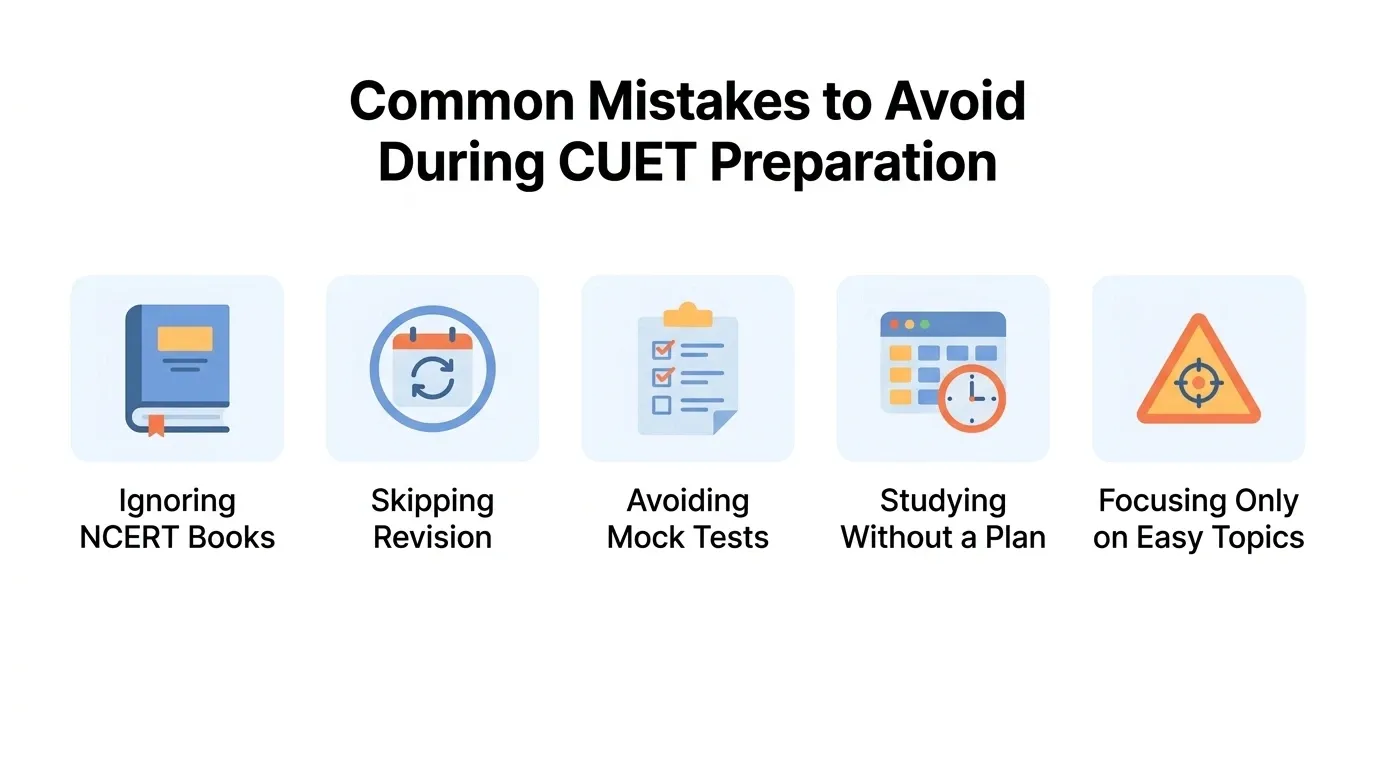
Most Common Mistakes
Students often:
- Ignore NCERT textbooks
- Skip revision
- Avoid mock tests
- Study without planning
- Focus only on easy topics
Avoiding these mistakes improves efficiency and results.
Best CUET Preparation Books 2026 (Subject-Wise List)
Choosing the right CUET preparation books plays a crucial role in improving accuracy, conceptual clarity, and exam performance. Since most questions in the CUET exam 2026 are based on NCERT concepts, students should begin preparation with the textbooks and then move to reference books. The table below highlights the best books recommended for each section to strengthen concepts, improve accuracy, and boost overall exam performance.
| Section | Recommended Books | Purpose / Benefit |
|---|---|---|
| Language Section | NCERT English Core (Class 11 & 12), Objective General English by S.P. Bakshi, Word Power Made Easy by Norman Lewis, High School English Grammar & Composition by Wren & Martin | These books help improve vocabulary, grammar rules, comprehension ability, and overall language skills required for the CUET language section. |
| Domain Subjects | NCERT Class 11 & 12 Textbooks (All Subjects), NCERT Exemplar Problems, Arihant Objective Series (Subject-wise), Oswaal Question Banks | NCERT-based preparation provides the strongest foundation for domain subject success and strengthens conceptual clarity. |
| General Test | Quantitative Aptitude by R.S. Aggarwal, Logical Reasoning by R.S. Aggarwal, Lucent’s General Knowledge, Arihant General Intelligence & Reasoning | These books help develop reasoning ability, numerical aptitude, and general awareness required for the General Test section. |
Referring to section-wise recommended books helps candidates organize their study materials efficiently and prepare in a structured manner for CUET 2026.
CUET Mock Test Strategy 2026
Mock tests are one of the most important tools in CUET preparation. They help students understand the exam pattern, manage time effectively, and improve accuracy.
Why Mock Tests Are Important
Mock tests help students:
- Improve time management
- Understand exam difficulty
- Identify weak areas
- Reduce exam stress
- Build confidence
Students who regularly practice mock tests perform better than those who rely only on theory.
How Many Mock Tests Should You Attempt
Recommended number:
- Beginner Stage: 1 mock test per week
- Mid Preparation: 2–3 mock tests per week
- Final Stage: 4–5 mock tests per week
Regular mock testing improves overall performance significantly.
How to Analyse Mock Tests
After each mock test:
- Check incorrect answers
- Identify weak topics
- Revise mistakes
- Attempt similar questions again
Mock test analysis is more important than simply attempting tests.
CUET Revision Strategy 2026
Revision is essential for retaining concepts and improving recall speed.
Daily Revision Plan
Students should:
- Revise formulas daily
- Review important notes
- Practice key questions
- Solve short quizzes
Short daily revision sessions improve long-term memory.
Weekly Revision Plan
Follow this method:
- Revise one major subject weekly
- Practice mixed questions
- Revisit weak topics
Weekly revision prevents forgetting important concepts.
Last-Minute Revision Strategy
During the final weeks:
- Revise short notes
- Focus on formulas
- Solve previous year papers
- Avoid learning new topics
Last-minute revision should focus only on strengthening existing knowledge.
CUET Time Management Strategy
Time management is one of the most important skills required to crack the CUET exam.
Time Management Tips
Follow these tips:
- Divide study time equally across subjects
- Set daily study goals
- Avoid distractions
- Take short breaks
- Maintain a consistent routine
Consistency improves productivity.
Time Allocation During Exam
Suggested strategy:
- Attempt easy questions first
- Skip difficult questions initially
- Return to challenging questions later
- Reserve last minutes for revision
This approach improves accuracy and reduces panic.
CUET Preparation Tips from Experts
Experts recommend following a disciplined approach to preparation.
Top Expert Tips
Follow these:
- Start preparation early
- Focus on NCERT textbooks
- Practice regularly
- Revise frequently
- Attempt mock tests
- Maintain healthy routine
Students who maintain discipline usually perform better in competitive exams.
CUET Preparation Tips Without Coaching
Self-study is a powerful preparation method if done correctly.
Self-Study Tips
Students should:
- Use reliable study materials
- Create structured timetable
- Follow online lectures
- Practice mock tests
- Revise regularly
Self-study helps students maintain flexibility and focus.
CUET Exam Day Preparation Tips
Exam day preparation plays a significant role in final performance. The table below highlights important actions to follow at each stage of the exam.
| Stage | What Students Should Do | Key Benefit |
| Before Exam Day | Revise formulas, Sleep well, Prepare admit card, Arrange required documents | Proper preparation reduces stress and ensures a smooth exam-day experience. |
| During the Exam | Read instructions carefully, Manage time properly, Stay calm, Avoid guesswork | Confidence and proper time management improve overall performance. |
| After Exam | Check unofficial answer keys, Estimate scores, Prepare for counselling | Planning ahead helps students stay ready for the admission process. |
Following these stage-wise exam-day guidelines helps students remain organized, confident, and prepared throughout the entire CUET examination process.