The CUET dress code is an important part of the CUET UG exam day guidelines issued by the National Testing Agency (NTA). Every year, thousands of candidates face delays or entry issues because of improper clothing or restricted accessories.
If you are appearing for the CUET 2026 exam, following the correct CUET dress code for female and male candidates is essential to ensure smooth entry into the exam hall.
The CUET dress code focuses on simple clothing, minimal accessories, and easy security checks, helping maintain fairness and security during the examination process.
Table of Contents
Why CUET Dress Code is Important
The CUET exam dress code ensures security, transparency, and fairness during the examination process.
Here’s why it matters:
- Helps in quick security checks
- Prevents carrying hidden electronic devices
- Reduces entry delays at exam centres
- Ensures uniformity among candidates
- Avoids last-minute dress-related rejection
In previous sessions, several candidates faced entry delays due to full sleeves, jewellery, and closed shoes, leading to stricter enforcement of dress code rules.
CUET Dress Code for Male Candidates
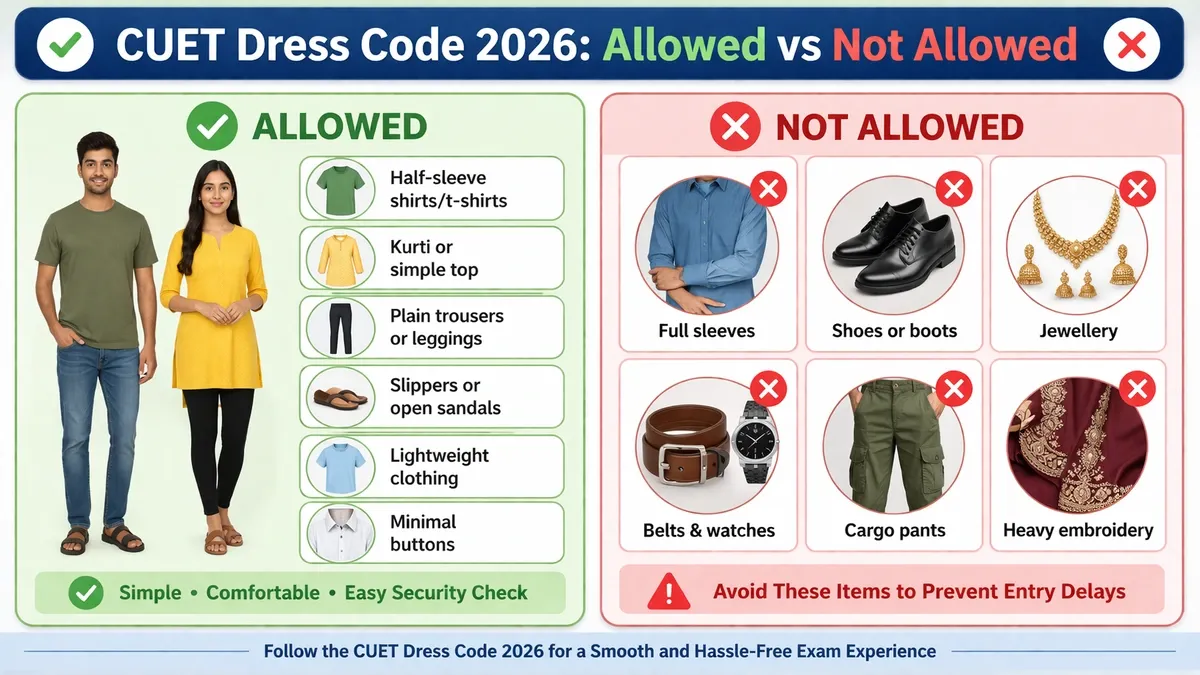
The CUET dress code for male candidates focuses on simple clothing without metal components.
Allowed for Male Candidates
- Half-sleeve shirt or t-shirt
- Plain trousers or simple jeans
- Slippers or open sandals
- Minimal buttons on clothing
Not Allowed for Male Candidates
- Full-sleeve shirts
- Kurta-pyjama (generally discouraged)
- Cargo pants or pants with multiple pockets
- Shoes or boots
- Belts, watches, caps, sunglasses
- Jewellery or metallic accessories
Male candidates should avoid clothing with large pockets or metal buttons, as these can delay security checks.
CUET Dress Code for Female Candidates
The CUET dress code for female candidates emphasizes simple attire without heavy accessories.
Allowed for Female Candidates
- Half-sleeve kurti or top
- Simple salwar, leggings, or trousers
- Light-weight clothing
- Slippers or sandals
Not Allowed for Female Candidates
- Full-sleeve outfits
- Heavy embroidery or layered dresses
- Jewellery (earrings, bangles, rings, chains)
- Fancy hair accessories
- High heels or closed shoes
- Dupatta or scarf (unless required for religious reasons)
- Decorative metal hair clips and fancy hair bands
Female candidates should choose simple, comfortable outfits that allow quick security screening.
CUET Footwear Rules 2026
Footwear guidelines are strictly enforced in the CUET exam.
Allowed Footwear
- Slippers
- Open sandals
Not Allowed Footwear
- Shoes
- Sneakers
- Boots
- High heels
Closed footwear is generally restricted because it may hide electronic devices or other prohibited items.
CUET Dress Code 2026 Checklist
Before leaving for the CUET 2026 exam, quickly review this checklist to ensure you follow the official CUET dress code and avoid last-minute issues at the exam centre.
Allowed Items Checklist
- Half-sleeve shirt, t-shirt, kurti, or top
- Simple trousers, jeans, salwar, or leggings
- Lightweight clothing without heavy embroidery
- Slippers or open sandals
- Minimal clothing accessories
- Religious attire (with early reporting if applicable)
- Transparent water bottle (if permitted at centre)
Not Allowed Items Checklist
- Full-sleeve clothing
- Shoes, boots, or high heels
- Jewellery (rings, bangles, chains, earrings)
- Watches or belts
- Caps, sunglasses, or fancy hair accessories
- Heavy or layered clothing
- Clothing with large pockets
Pro Tip for CUET Exam Day
Wear simple half-sleeve clothing and slippers, carry only required documents, and reach early to avoid delays during security checks.
CUET Dress Code for Medical Reasons
Candidates with medical conditions that require special clothing, accessories, or medical devices must obtain prior approval from the National Testing Agency (NTA) before appearing for the CUET 2026 exam.
This ensures that candidates with genuine medical needs are allowed necessary items without facing entry issues at the exam centre.
Important Guidelines for Medical Exceptions
- Candidates requiring medical-related dress or items must obtain official approval from NTA in advance.
- Relevant medical documents and prescriptions must be submitted during the approval process.
- Medical items such as braces, supports, or medical footwear may be allowed only after verification.
- Without prior approval, candidates carrying restricted items may face entry denial or delays.
Tip:
If you have any medical condition requiring special dress or accessories, contact exam authorities well before the CUET exam day to avoid last-minute complications.
CUET Dress Code for Religious or Customary Articles
Candidates wearing religious or customary attire such as hijab, turban, kara, or other articles of faith are permitted to appear for the CUET UG exam, but additional verification procedures apply.
Important Instructions
- Candidates wearing religious attire must report at least 2 hours before the reporting time.
- Additional security and frisking procedures will be conducted.
- Religious clothing or articles will be checked thoroughly during verification.
- If any suspicious object is detected during checking, entry may be restricted until verification is completed.
Important Note:
Candidates are advised to plan their travel accordingly and reach the exam centre earlier than usual if wearing religious attire.
Documents to Carry with CUET Dress Code
Along with following the CUET dress code 2026, candidates must carry certain mandatory documents to gain entry into the CUET exam hall.
Failure to carry required documents may result in denial of entry, even if dress code rules are followed.
Mandatory Documents to Carry
Candidates must bring:
- CUET Admit Card (printed copy)
- Valid Photo ID Proof (Aadhaar Card, PAN Card, Voter ID, Passport, etc.)
- Passport-size Photograph (same as uploaded in application form)
- Self-Declaration Form (if mentioned on admit card)
- PwD Certificate (for candidates claiming PwD category benefits)
Tip:
Keep all documents in a transparent folder to speed up verification at the exam centre.
CUET Exam Day: Items to Carry vs Not Carry
Before leaving for the CUET 2026 exam, candidates must check both allowed and prohibited items to avoid last-minute issues at the exam centre.
| ✅ Allowed Items | ❌ Not Allowed Items |
| CUET Admit Card | Mobile Phone |
| Valid Photo ID | Calculator |
| Passport-size Photograph | Smartwatch |
| PwD Certificate | Books or Notes |
| Transparent Water Bottle | Bluetooth Devices |
| Self-Declaration Form | Wallet with metal |
Reporting Time Related to CUET Dress Code
Following the correct reporting time is as important as following the CUET dress code.
Arriving late or at the last minute may increase the risk of entry delays due to security checks.
Reporting Time Guidelines
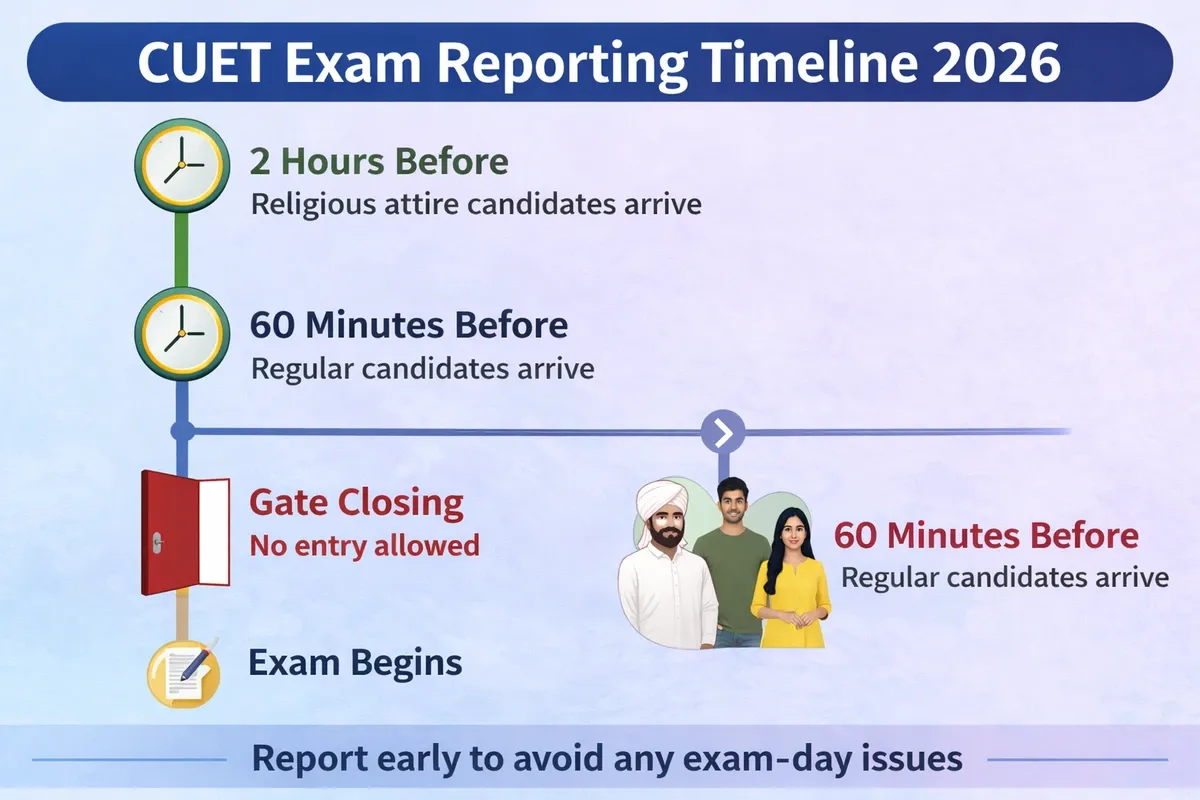
- Candidates should report at least 60 minutes before exam time.
- Candidates wearing religious attire must report 2 hours early.
- Entry into the examination hall is not allowed after gate closing time.
- Late arrival may result in missing the examination.
Tip:
Always reach the exam centre early to allow enough time for security screening and document verification.
CUET Dress Code: List of Banned Items
Apart from clothing, certain items are completely prohibited inside the CUET exam hall.
Clothing Restrictions
- Full sleeves
- Heavy embroidery
- Layered outfits
Accessories Not Allowed
- Watches
- Rings
- Bracelets
- Chains
- Belts
- Sunglasses
Electronic Items
- Mobile phones
- Smartwatches
- Bluetooth devices
- Earphones
- Calculators
Other Prohibited Items
- Wallets with metal
- Books or notebooks
- Food items (unless medically required)
Carrying restricted items can lead to entry denial or delays.
What Happens If You Don’t Follow CUET Dress Code?
Failure to follow the CUET dress code 2026 may result in:
- Entry delays
- Removal of restricted items
- Extra security checks
- Denial of entry in extreme cases
Following dress code rules ensures smooth entry and stress-free exam experience.
CUET Exam Day Dress Tips (Expert Advice)
Here are some practical tips to help you follow the CUET UG dress code easily:
- Wear half-sleeve clothing
- Avoid metal accessories
- Carry minimal belongings
- Choose comfortable slippers
- Reach the exam centre early
- Keep spare simple clothing if unsure
These tips help avoid unnecessary delays during the CUET exam.
Frequently Asked Questions
No, full-sleeve clothing is generally not allowed in the CUET exam because it can delay security checks. Candidates are advised to wear half-sleeve clothes.
Yes, girls can wear simple jeans as long as they are plain and do not have multiple pockets or metal accessories.
No, shoes are not allowed. Only slippers or open sandals are permitted as part of the CUET footwear rules.